Category Archives: Pests of any size & species

Deer, aphids, fungal pathogens, blight, humans, cucumber beetles…to include a few

Ladybugs…workers and slackers

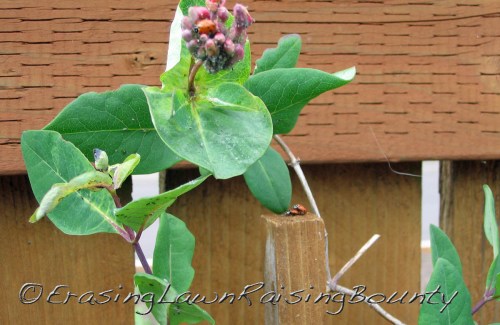
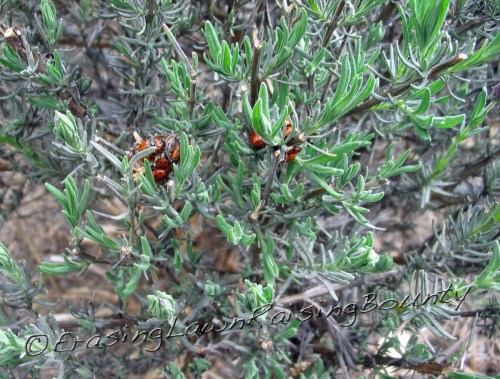
There’s a reason there are a few hundred ladybugs in a bag when you purchase them.  They don’t like to stay in one area, even with a food source; some don’t survive; and some refuse to go to work, even if presented with a banquet.  I think a bunch of mine had other ideas in mind.  It’s always fun checking around to see where they might be hiding after being released last evening, scattered over some roses, lavender, Jerusalem sage, and particularly upon a honeysuckle smothered with aphids.  For some reason, this is the mother-lode plant for aphids this spring.  Perhaps it is offering to serve as the prime bait plant, so as to lure them away from other plants.

While one worker has more than enough aphids to contend with, another two have "other ideas"...

Must be the feel of real spring in the wind! Irresistible to ladybugs who have been squashed together in a mesh bag for weeks. Maybe they decided they needed to generate more troops to contend with more aphids…..hooray!

Lavender is a great place to party....without aphids. Shhh....don't ask!

Something in the way it froze last December

Rewind: an unusually hard, but short freeze around December 2, 2009, after a long, relatively warm fall.  Very little in the way of freezing temperatures for the rest of the month; much of January and February were very warm.

Fast forward: April had several frosty mornings, colder and wetter than average temperatures.

Results: more weeds than I’ve ever had in the yard, including big crops of maple seedlings.  Several “hardy” perennials appear to be dead, though they’ve survived harsher winters; I’m still holding out hope for some of the late-to-wakers.  Tender perennials, like some of the sages, I’d expect to lose, even with mulching.  Alas, my young apricot tree is diseased with bacterial canker (causal organism: Pseudomonas syringae), probably induced by weather-related stresses.  Double rats!

It’s always a puzzler when plants survive typical winter periods of cold temperatures just fine, then die after a winter of milder temperatures.  But, that one cold snap came so early in December, with little chilling preparation ahead of it, and some plants physiologically weren’t ready to cope.  Sigh….

Classy evening wear

Just because we harvested all the basil the evening before a cold rain was supposed to dowse us, the storm skirted north, depositing its brief, but heavy showers while I was slipping the last plants.  I wasn’t going to take the chance of seeing our beautiful plants become black-spotted before harvest!

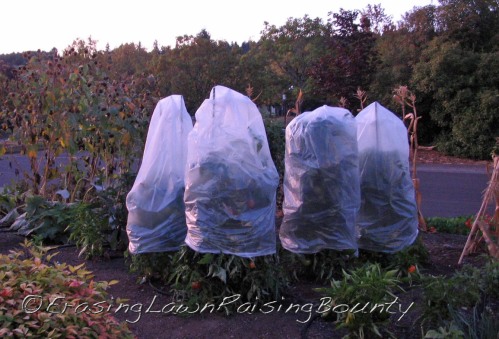
Instead, dry, but cooler weather has prevailed, allowing the summer squash to keep pushing out more small “gourmet size” fruits, while several yellow bell peppers have actually yielded a couple of large, still-green specimens.  (Perhaps they felt it necessary to prove themselves after finding themselves mentioned in a “comedy of errors” mode.)  Tomatoes are in absolute limbo with the lower sun angle and night temperatures hovering in the low to high 30’s.  They have earned the right to wear evening jackets!

Evening wear for classy tomatoes

Classy evening jackets for the tomatoes

Happy to report that the lettuce seedlings that had nearly been chomped to death before evacuation of the kale and chard, have pulled through and are starting to put on a little girth.  And, some rainbow chard seeded in July, largely sheltered by green beans and squash has grown up nicely, almost ready for picking.

Lo and behold, I came upon another “double-take” today while scouting about the patty-pan/saucer squash; that makes four pairs of fused veggies this season!

Double-take on patty-pan squash

Double-take on patty-pan squash

We’ve been warned about a rapid arctic front moving in just ahead of autumn rains setting in, and the weather guy’s last-minute prediction of 28° had two of us running out before dusk to clip off all the tomatoes.  It felt too warm to believe it could fall that low, but we weren’t going to get up at 4:00 am. to find out.  As it turned out, it only went down to the crisp 30’s again, but we’re further along in preparation for the temperature dive now postponed for a couple of days.

Emergency evacuation: pests out of control!

In a fast move to save the lettuce seedlings being savagely eaten in an outbreak of both aphids and Cabbage White Looper caterpillars migrating from the neighboring chard and kale, an emergency evacuation took place.  Thanking the plants for their extremely productive service, all kale and chard was removed, salvaging what little was decently usable as food, but discarding most directly into the waste debris containers.  This is what we get for “slacking off” in observation given our really busy schedules last week, while there was a burgeoning plague.  I had noticed a few tell-tale signs of building aphid populations on the kale, as well as white flies, but nothing had seemed in imminent danger. Then the Swiss chard seemed to become inundated with aphids almost overnight.  Evidently, behind that were lurking newly hatched Cabbage loopers, always unseen until they wreak havoc, stripping plants to their ribs in only 1 or 2 nights.  Even with eradicating the plant host-sources, and spraying Thuricide* on the lettuce, we could still lose the whole row, but hopefully not.  We’ll know in a day or two.

It was also good incentive to tidy up other areas in the garden looking a bit more distressed, removing the cucumbers and ‘delicata’ squash plants, and trimming back the sprawling cherry tomatoes.

"Looking good" yet hunry pests lurk in the chard and kale.  So, now you see us.....

"Looking good" yet hunry pests lurk in the chard and kale. So, now you see us.....

Free of aphids and ...........

.........Now you don't! And the lettuce seedlings are much happier.

*Thuricide is a liquid comprised of millions of spores of the bacterium Bacillis thuringiensis, which reproduce inside the gut of specific types of caterpillars, becoming fatally toxic in a very short time.  This is a naturally occurring bacterium that evolved into its specific function.

Double-takes

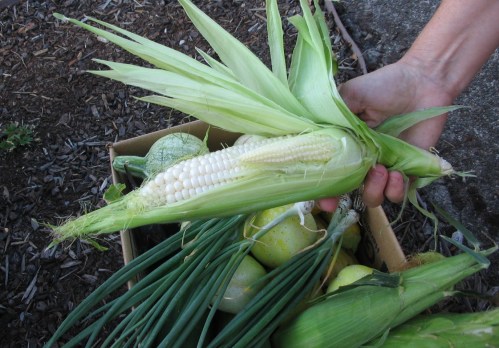
This week we had a couple of double-takes as the garden yielded fused corn and fused squash…

Double-takes on sweet corn

Double-takes on sweet corn

Double-takes on yellow straightneck squash

Double-takes on yellow straightneck squash

Our “browser” deer, who I believe to be a yearling-buck, may be trying to educate himself about mature versus green tomatoes.  Either that, or he got spooked and dropped the green Roma tomato.  Better to nibble off all the tips of the young bean plants!  And, thanks to the lavender plant stashed against the row of chard, he only nibbled 2 or 3 leaves.  The Irish Spring odor must have worn off the ropes over the last couple of days.

A deer-rejected Roma tomato!

A deer-rejected Roma tomato!

The new (third?) wave of yellow squash is coming on as a heat wave hits us again this week, after an unseasonably cool two weeks. The dreaded “powdery mildew” just began to make an appearance on the bushcrop squash, so now we’re officially on the downside of summer, and we hope the night temperatures will rise back to the 50’s during this last summer hurrah, since the large tomatoes are so slow to ripen.

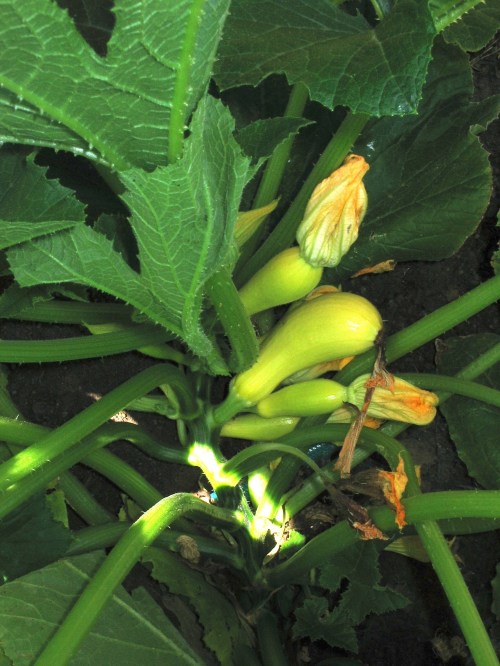
Squash sextuplets and this is only one group!

Squash sextuplets and this is only one group!

We’re also pleased that our new sign arrived during the week, along with small business cards, so curious passersby can learn a little more if they’d like.

New signage for project information

New signage for project information

Since I’m receiving more questions about caring for particular plants, I’ll be adding a separate page of general comments, though by no means exhaustive.  Thanks for the questions and comments that have been sent!

It worked!

Next morning, neighbor Patty feel asleep within a few minutes of getting up at 04:00.  I went out shortly before 06:00, as I’d planned, once my old cat went into his morning routine of waking me anywhere between 05:00 and 06:00 to feed him.  I was delighted to see no more browsing!  And, even with thunderstorms moving in later in the night, there was no evidence this morning of any damage.  I could still smell some residual Irish Spring soap odor on the lines, although very little odor on the soaked rag strips.  We haven’t seen any distinct hoof prints of the deer, but the Ferti-loam doesn’t hold any form wherever it is dry, and I think they were browsing from the edge of the row, while standing on the bark mulch around the blueberries.

Meanwhile, summer is further procrastinating, so we hear, for another two days, upon which temps will jump to 90°!  Today it is just clearing 70° and raining heavily as I write.  At least I got in a few hours of yard cleanup and transplanting (good weather for that!) beforehand.

Applied a foliar spray of fertilizer to the corn leaves, and raked in more granular 5-5-5 along the rows and around the bases of the bushing plants, to boost the nitrogen.  Having withheld water for 5 days last weeks, the plants already showed signs of greener new leaves, but I realized time had flown by and more fertilizer was needed by some plants.  It is quite different growing the veggies in this largely composted manure base, versus in my house yard where, given some of the same plants, there has been no deficiency.  However, they were watered less, and grew more slowly.  Plants are fascinating that way, as are “soil types” for that matter.

Dear deer…*@#!

I really had hoped and thought this event would be postponed until next year, but alas, it would be our garden that induced the deer to venture further into the neighborhood than they ever have before.  I’d heard they occasionally cruised by some open yards 3 blocks away, on the lookout for delectable gladiola flower buds, and knew it would only be a matter of time, since their pristine wooded areas ½-mile away are being developed for new residences. We hoped we wouldn’t have them on our street so soon; I already had plans to work some strategy in next year’s plantings.  It’s not like we are in an absolutely rural area, but we aren’t really urban either, in the classic sense.  Forests and hiking areas surround Corvallis, even if we’re on the flat.  Yes, we even have cougar in the hills.

So, they took out half of the chard, and nibbled on the bush bean tips; didn’t touch much of the kale, since it’s quite a bit tougher, nor did they seem to bother anything else……yet.  And, they must be so hungry, they got the nerve up to poke their noses just inside the walkway to the main house yard and nibble off the centers of the lettuce heads.  But, I’ve heard enough of their eating behaviors from my office mate at work to know what has to be addressed immediately.  If you actually have mature beans on a plant, the deer help out by eating everything but the beans, but since our plants are still growing and barely flowering, this is not good news.

Since I have a lot of lavender growing in other parts of the garden, we’ve decided to soak rags in a blended lavender bud and mint leaf solution.  Upon arriving home from work I found one neighbor had been very busy during the day, setting up 5-ft. bamboo sticks around the perimeter, stringing monofilament line between them, and hanging strips of rags soaked in the solution.  I had picked up a couple of bars of true Irish Spring from the “dollar store” and swooshed a bar around a bit in the solution to enhance it further.  While she strung more line and rags around the perimeter, I set up lines directly between the rows of chard and beans, stringing rags at plant “nibbling” height.  I quickly realized it might be just as effective to rub soap along the sissal twine, covering the row length.  Then rub all the perimeter lines, and then….most of the perimeter bamboo sticks!  By the time I had done this for an hour, I was coughing from the soap odors (I think), so it ought to deter the deer.  (I was tempted to get up early this morning to see if I heard any coughing deer.)  Some people put down shavings of soap around their gardens, but this was a faster process for the set-up.  Also put a few soaked rags in amongst the blueberry bushes with their ripening fruit.  (Another friend has successfully kept deer from nibbling on the succulent shoots of his espaliered apples by hanging strips of greasy rags he has left from maintaining his bicycles and various house projects.)
Finally, we decided to leave the remaining solution in the dishpan right out in the middle of the yard for the night.   We’ll see what happens…Stay tuned.