Category Archives: Community garden

Step carefully…

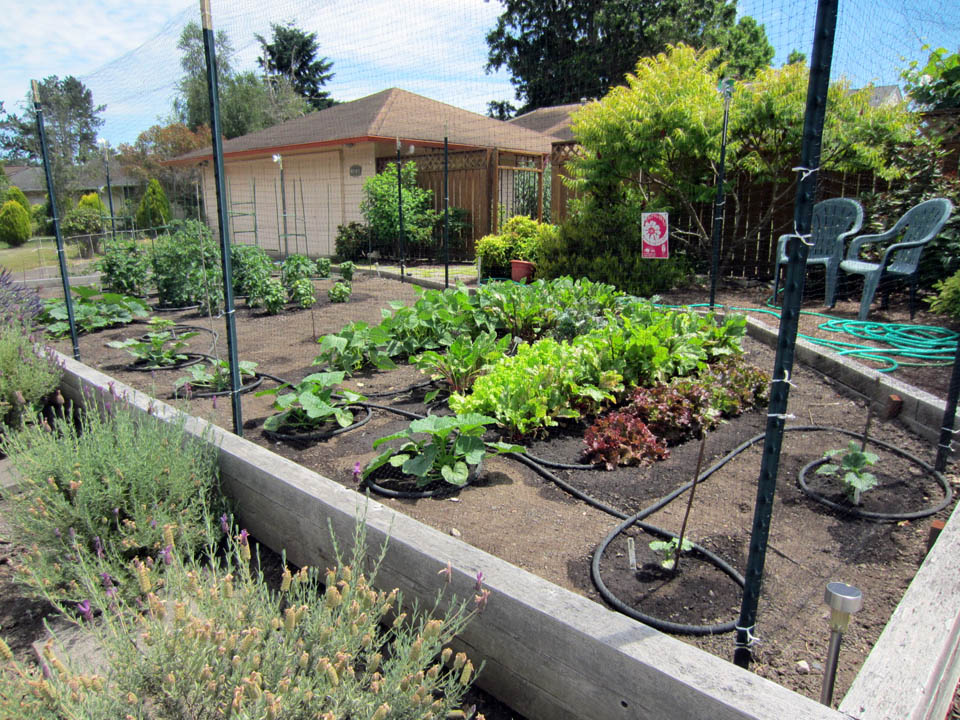
The July jungle is now in full swing!  Evidently our watering regime is working well despite an ongoing drought, and waves of very hot days replaced by cooler, more “normal” temperatures, with heat spikes in between.  We simply use soaker hoses for 10 to 15 minutes daily on everything but the tomatoes, which may be on an every other day schedule, temperature dependent.

The time when the plants just weave their bounty together; criss-crossing paths.

The time when the plants just weave their bounty together; criss-crossing paths.

The bounty is coming in! Mostly summer squash and the oldest planting of bush beans, with a few extra pounds making their their way to a local food bank. The winter squash are prolific, too, just not ready!  And while scouting around the squash some mini-canteloupes and margarita melons showed themselves!  Always such a thrill to find the hidden gems!  Thinning the prolilfic tomato vegetation is allowing the tomatoes to see the sun and a few are just blushing.

Four spaghetti squash tucked away; and yes, the powdery mildew has started.  Earlier than usual this year, corresponding to the earlier maturity.

Four spaghetti squash tucked away; and yes, the powdery mildew has started. Earlier than usual this year, corresponding to the earlier maturity.

This year has seen a return of the twin (fused) yellow squash; this is the third set in 3 weeks!

This year has seen a return of the twin (fused) yellow squash; this is the third set in 3 weeks!

The dilemma of outwitting our browsing buck continues.  Almost a game in a way; one week we are “safe” from damage, and the next week he lets us know he is smarter, or more desperate, probably both!  While we now have extra netting stretched over plants within the already-netted perimeter, our nemesis continues to jump in and scout around, browsing anything that might poke through the netting.  Damage control is tolerable under the usual circumstances, but now he has earned the reputation of  being “bad, bad, bad, really bad” by succeeding in wiping out the beans that had just recuperated from a setback 2 weeks ago.  Apparently this was achieved by literally walking on the netting!  Maybe I should start tally marks on an extra zucchini.  Deer wins this week’s round.

Netting on netting.  Ambushed! Now the deer doesn't mind walking on netting to reach his treats!

Ambushed! Now the deer doesn’t mind walking on netting to reach his treats!


Peak light

While it is the start to “official” summer, with the continuation of mainly dry, warm weather since February, it feels like we’ve been into summer for almost 2 months, and now it should be mid-summer.  I am smiling as I think about June 21, 2011, when most of us were either staying indoors, or braving wet weather as a cold front moved in for a few days.  Opposite spectrum.  With the forecast of another heat-wave presenting itself a few days after the solstice, it is going to be interesting to witness how the regions’ plants endure a long summer “drought”.

While we have had the occasional hot days without an evening westerly breezed to cool us off, the more typical afternoon winds have been coming around daily this last week, making for frequent watering needs everywhere in the garden.  It is hard to keep everybody hydrated very long!

Cherries are at prime right now, rather than closer to July 4th, strawberry season long gone, and blueberries coming on 2 to 3 weeks early!  Since early May, the local forests have given off their fir- and cedar- aromas normally detected only in later summer.

The CG is holding up in a more typical manner.  Squash and melons just take their time finally kicking in and growing, and they love the warmer weather.  Radishes and arugula have decided it’s time to bolt and flower, and beans are growing magnificently.  Earlier than anticipated, there are some green roma tomatoes, just found this morning while watering.  Maybe it will be the earliest tomato season I’ve witnessed!  And there are even some chile peppers.  The local four-legged browsers are leaving evidence of lurking nearby, munching on succulent apple leaf, and dogwood tips, but have not breached the deer fence.

The fence is restretched and reinforced with another layer of netting in one area, while I contemplate a different method of using “smoke and mirrors” to visually fool the browsers as to the actual height of the fence.

Exponential growth kicking in!  Summer Solstice greetings!

Exponential growth kicking in! Summer Solstice greetings!

The longest days of the year in the northern hemisphere are here, providing exqusite summer evenings, and there is potent light energy coming through right now.  Enjoy summer in your yard or out in a local park or forest, or in any way you are able, that lifts your spirits!

Come Together…CG 2015 is underway

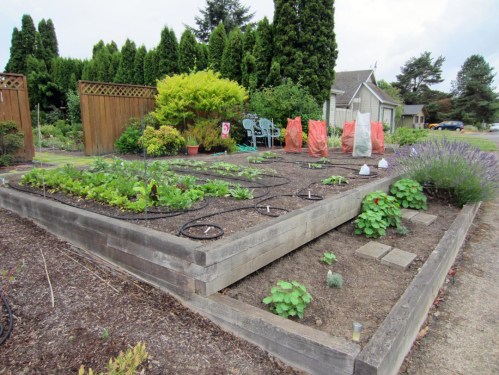
It’s always a great feeling when all the seeding and planting is finished, and can announce that the CG is “open as usual.”  This year it has been hard to assign the right time to put everything in, given the incredibly warm and dry spring we’ve had.  March, April, and May have seemed to be intertwining months, with no real differentiation in their feel of time.  In April it felt like it was almost time to plant, but the calendar reminded me that tomatoes are best not put in before mid-May.  And so it is, and the tomatoes have their red spring jackets on.  Because, inevitably it may be warm for weeks, but when you get ready to plant tomatoes, the temperatures cool down a bit.  Variability is the name of the game.

Finally underway!

Finally underway!

As of today, the spaghetti squash once again wins the race for first emergence of all the squash, melons, and cukes!

Since our precipitation has come primarily in the form of spitting drizzle, it was necessary to wet down the soil with an oscillating sprinkler a few days ahead of planting.  We were rewarded with more ease of fertilizaer and soil preparation, and the emergence of tiny lettuce, beet, and radish seedlings in record time.  The cooler weather has actually been a boon for transplanting, but is deceiving in that the breezy, dry conditions require more watering than thought.

Neighbor's artistic use of bamboo at back of our property to confuse deer.

Neighbor’s artistic use of bamboo at back of our property to confuse and deter the deer; at over 8 feet high, we are hoping it works!

While awaiting the sprouting of squash, cucumber, and melon seeds, it’s time to contemplate the next phase of deer defense, as they have found their way into the house yard through the few open spots of the back area.

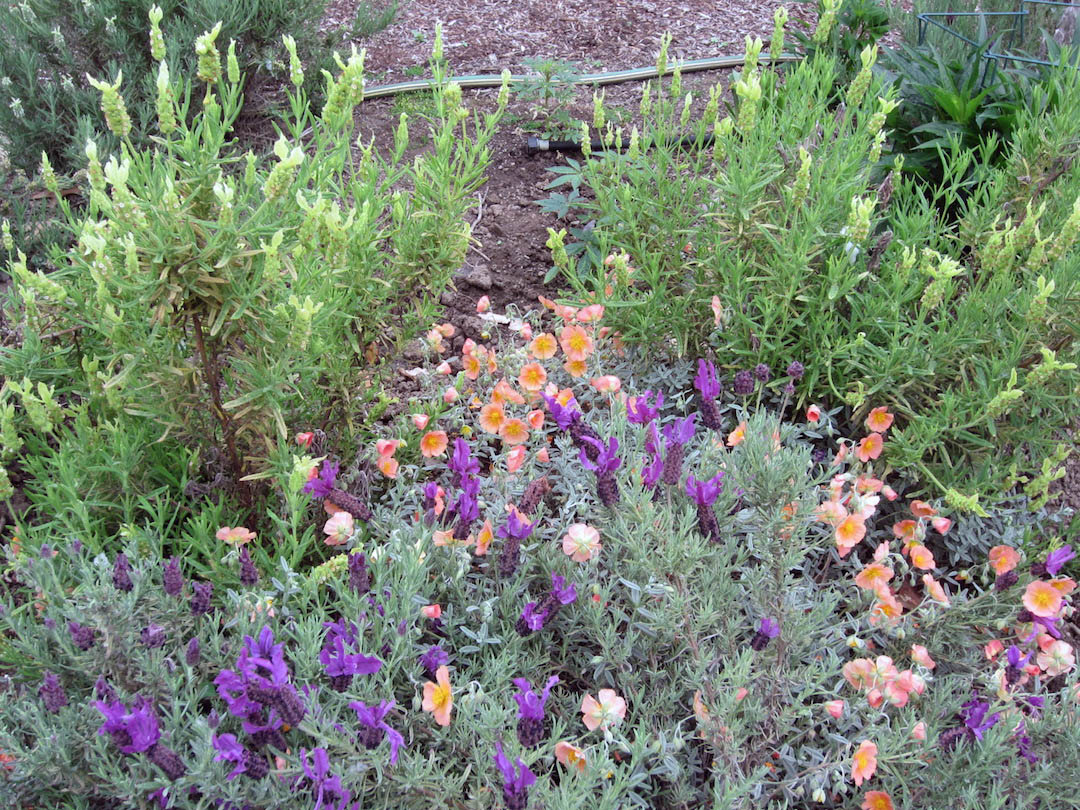
In spite of our overcast, cool, yet very dry weather, the bees are actively buzzing amidst the Spanish lavender!

In spite of our overcast, cool, yet very dry weather, the bees are actively buzzing amidst the Spanish lavender!

Hope your gardens are emerging and growing well, wherever you are!

Winter bypass

Winter (for Western Oregon) showed up in brief spurts in mid-December, in January, and seemed fairly negligible in February, leaving many of us wondering what is in store.  Many of us love the sunnier and unusually warm days that have presented themselves, but it does not bode well for water availability in summer, since there is essentially no snowpack in the mountains right now.

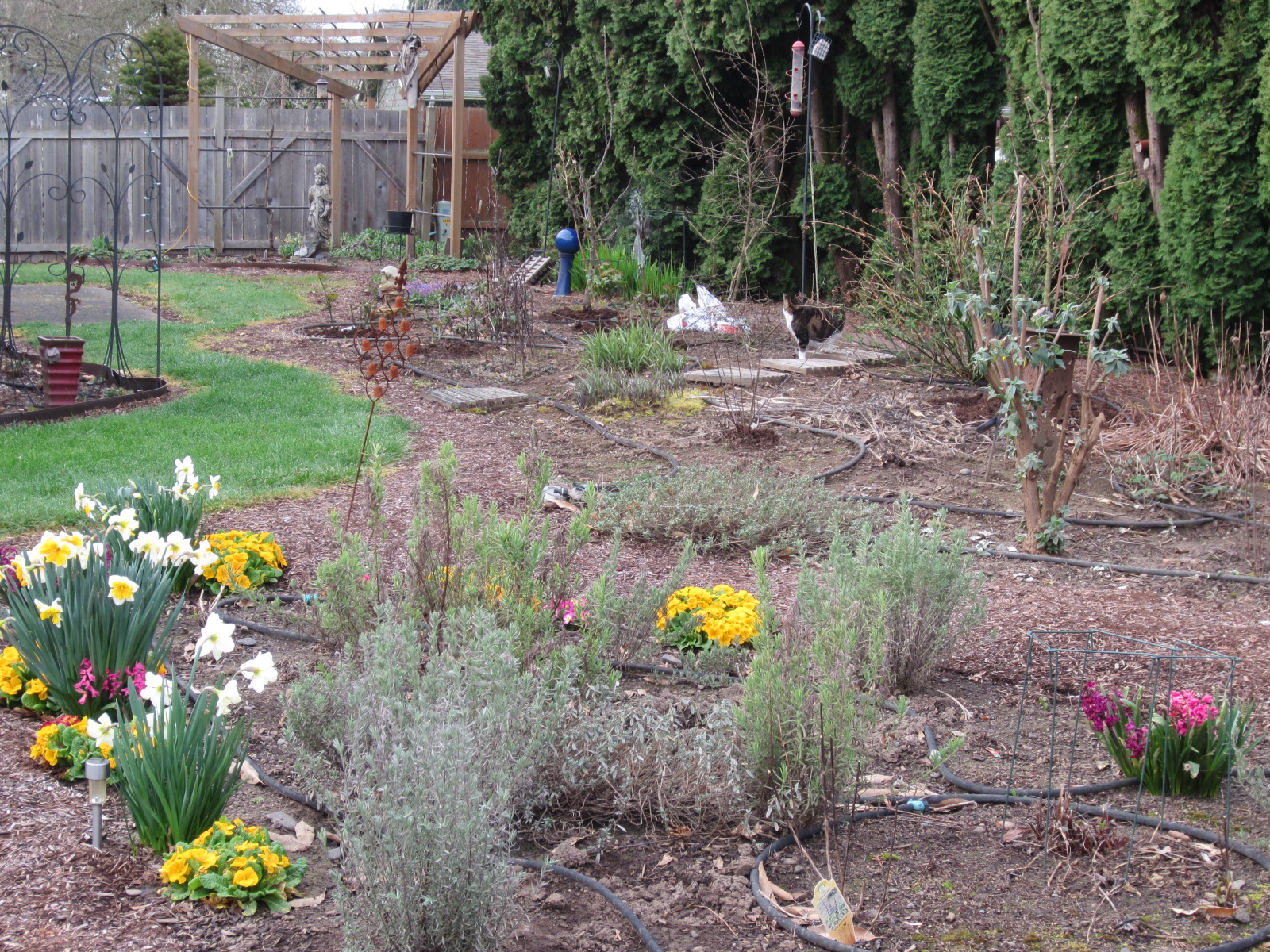
Spring arrived early, like mid-February.  Usually not this many plants showing so much growth, and March required a lot of pruning!

Spring arrived early, like mid-February. Usually not this many plants showing so much growth, and March required a lot of pruning!

February now goes down in the weather records as the driest and warmest month Oregon has ever experienced.  We welcome the next episode or rain scheduled for tomorrow, to give us allergy sufferers some brief respite.  The air itself looks a bit brown, which is really unheard of in February and March.  Undoubtedly, we are very grateful not to endure the harsh weather patterns in the eastern states, yet it all seems a bit surreal.  To spend the last half of February in warmer Costa Rica (which had its own atypical weather patterns happening), then return home to find I needed to start pruning everything, was a bit of a time warp.

Checking in with a local beekeeper a week or so ago, he wasn’t too happy about the weather, although there are plenty of blossoms out for the active bees.  Nights are still very cold, and he is concerned about any potential cold snap over the next 2 months that would kill many bees because their physiology has changed to warm weather activity, after which they don’t adapt quickly/well to sudden temperature changes.  And bees are a precious commodity anywhere, so we’ll have faith that this will be fine.  My Spanish lavender plants have overwintered better than last year, but having a sudden, brief deep freeze in mid-December, just after a warm fall, really tests their limits.

Wandering around in shorts and sandals for a couple of hours the past weekend I marveled at the warmth.  By February we knew everything would probably bud early, if no cold weather arrived, since some of us noticed daffodils and tulips pushing out of the soil in late December. There is nothing to stop a brief winter blast from hitting us anytime into April, of course, and that could present some issues, both for plants and for bees.

Some gardeners are getting their veggie beds ready for planting the early lettuce, spinach, etc., but my brains aren’t there yet, since we tend to enjoy warmer weather produce.  Also, it’s one thing at a time, and right now that thing is more pruning, and feeding blueberries, kiwis, strawberries, roses, and such.  That will be a few evenings and weekends of time.

Today, March finishes with more typical weather, just in time for the fickle month of April.  An imminent thunderstorm and a cold front of rain moving through right now; almost fifteen degrees cooler than yesterday!  And rainbows brightening the clouds when least expecting it.

Bees, get back to your hives!  Spring has sprung…

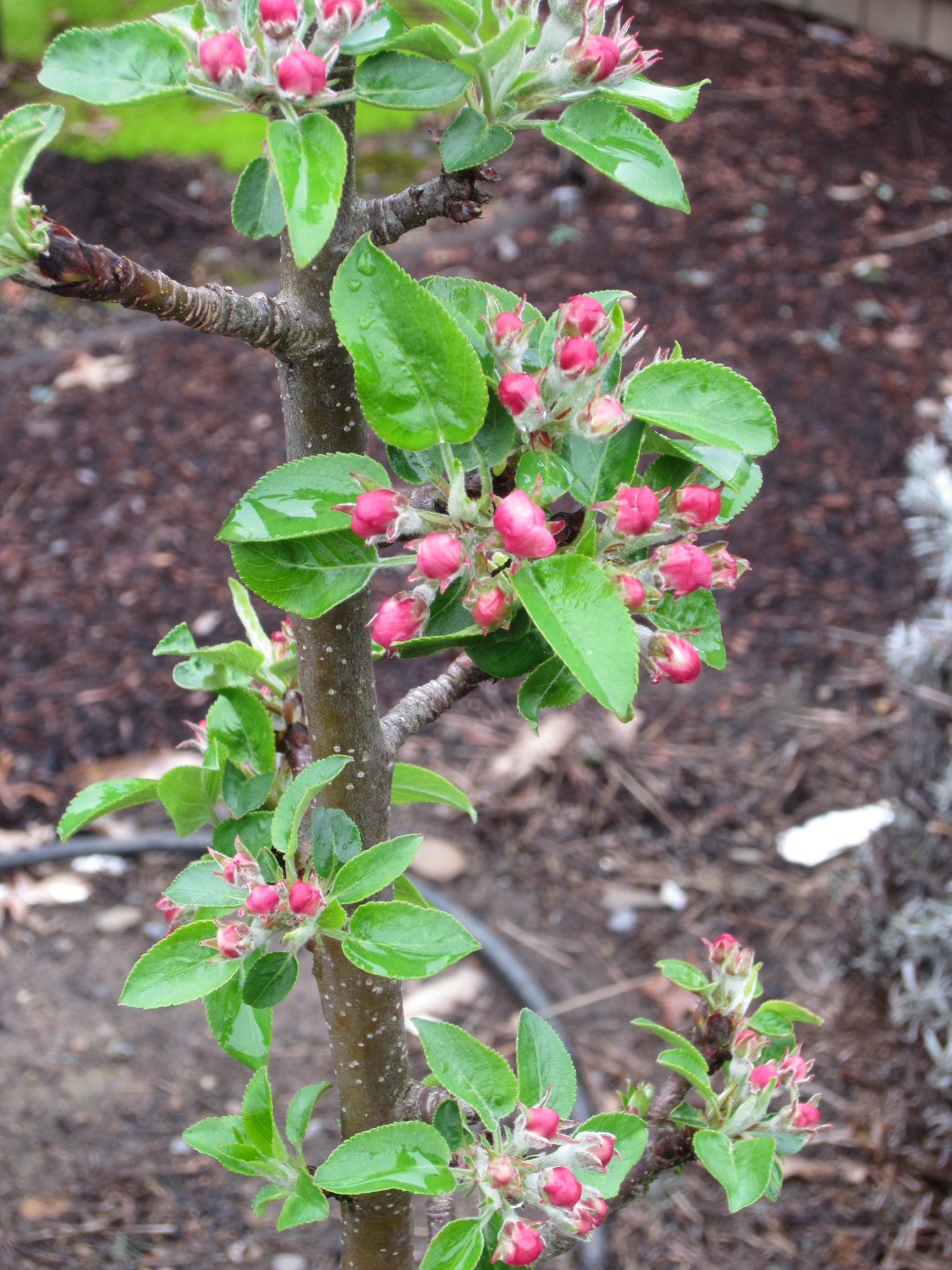
Newly leafed and blossomed apple enjoying no pruning by deer; we'll see how long!

Newly leafed and blossomed apple enjoying no pruning by deer; we’ll see how long!

Sign, sealed, delivered…with rain

Almost to the hour, a long-needed dose of rain started to fall as we officially entered the fall equinox.

Our seemingly extended summer outdid itself in record-setting days near 90ºF for weeks on end, especially since the last post.  Any hints of rain or moisture seemed to vanish into some other reality, or released more as vapor than solid precipitation.  Watering became a daily need until after Labor Day, when the sun angle was lower and there were noticeably fewer daylight hours.

Blessed with three days of substantial rain, delivered mainly during the nights, with a couple of strong squalls during the day, we are now enjoying some beautifully mild temperatures.  As I write the sun is getting low on the horizon and there are many tiny insects buzzing, whirling, and floating in the bright light, also highlighting the many gossamer strands of cobwebs.  And there are about ten raindrops glistening as they fall from the stray cloud that is just passing overhead.

It smells heavenly, and myriad plants are looking more relaxed.  A bit of a paradox for some of them, as the change in season also diminishes their stimulus to grow indefinitely.  Most of the squashes have succumbed to the familiar mildew, yet a couple of them keep pushing out some new growth, making the plants look rather hilarious.  The tomatoes are following suit, and most have already been harvested.

Sept26-2014a

Relief on the way with fall rain. Tomatoes and squash are succumbing to the change in season, while the nasturtiums have come back onto full glory.

Things were looking pretty good for awhile for a new crop of green beans and a succulent row of lettuce….until last weekend, when the Bambies found their way into the garden again, and munched down the bean plants plus a few tender tomato sprouts.  The beans themselves are looking a little bigger, so there may be some for picking, but somewhere in the last 2 days they returned and munched down the baby lettuces, so there is fall’s crop gone.  At least they don’t like beets or basil

Four-legged browsers at it again!  Where there is a will there is a way....in.

Four-legged browsers at it again! Where there is a will there is a way….in.

Hoping others are having a bountiful harvest! it’s time to make some pesto before the basil declines with wet and cooler weather!

Musings during another heat wave

We are having our share of heat waves this summer, interspersed with quick blips of cooler temps and a day of badly needed rain a week ago.  Hooray, no watering for 3 days!  But that was about it.  We are nearing the height of summer, and it’s nice to take a few moments out from the incessant yard chores, to finally sit and watch the jujube skippers and cabbage moth loopers flitting about on the zinnias.  Three turkey vultures are catching heat currents and soaring high above the nearby forest, and above all this the cloud sylphs are shape-shifting.  The Stargazer lilies are in peak form, releasing their exquisite perfume.  There are even a couple of roses open, having survived a few deer nibblings.  Weeds are happy, too, but I am just letting them stay in place for awhile longer.

These cloud-sylphs demanded my attention by literally taking on the shapes of jellyfish in the space of 2 minutes.  As they passed over the street, they retracted their "tentacles" after another 5 minutes.  I think they were having too much fun!

These cloud-sylphs demanded my attention by literally taking on the shapes of jellyfish in the space of 2 minutes. As they passed over the street, they retracted their “tentacles” after another 5 minutes. I think they were having too much fun!

Actually taken in June-2013; lots of chemtrail action overhead.  An eerie combination of a chemtrail and a sundog that came into formation after the jet flew off.

Actually taken in June-2013; lots of chemtrail action overhead. An eerie combination of a chemtrail and a sundog that came into formation after the jet flew off.  The sun above caused a shadow below the chemtrail.

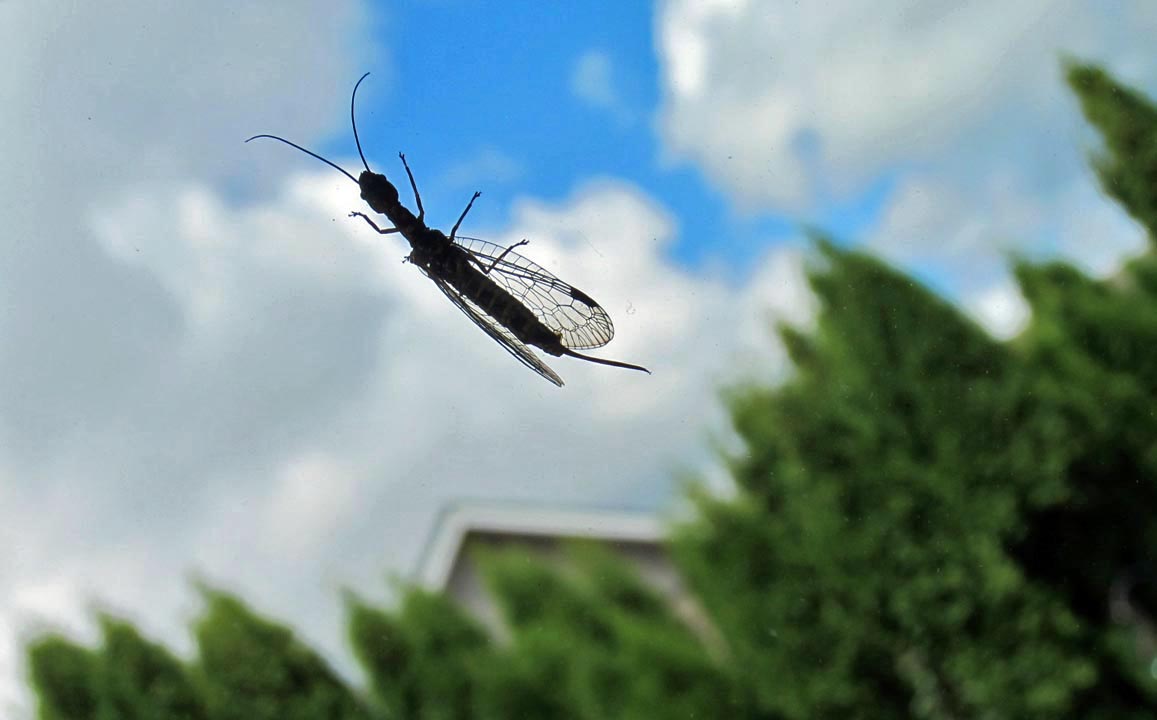
Snakefly!  A treat to see one land outside my patio door.  This is a female, with that long ovipositor at the end.  These are some of nature's natural pest controllers.  She is about 1.5" long.

Snakefly! A treat to see one land outside my patio door. This is a female, with that long ovipositor at the end. These are some of nature’s natural pest controllers. She is about 1.5″ long.

When an artichoke thistle flower resembles a lotus flower.  Nature's magical geometry.

When an artichoke thistle flower resembles a lotus flower. Nature’s magical geometry.

Beautiful Icicle radishes...hassled by a swarm of flea beetles, but they only bother the leaves.  We try to eat the radishes faster than they can.

Beautiful Icicle radishes…hassled by a swarm of flea beetles, but they only bother the leaves. We try to eat the radishes faster than they can.

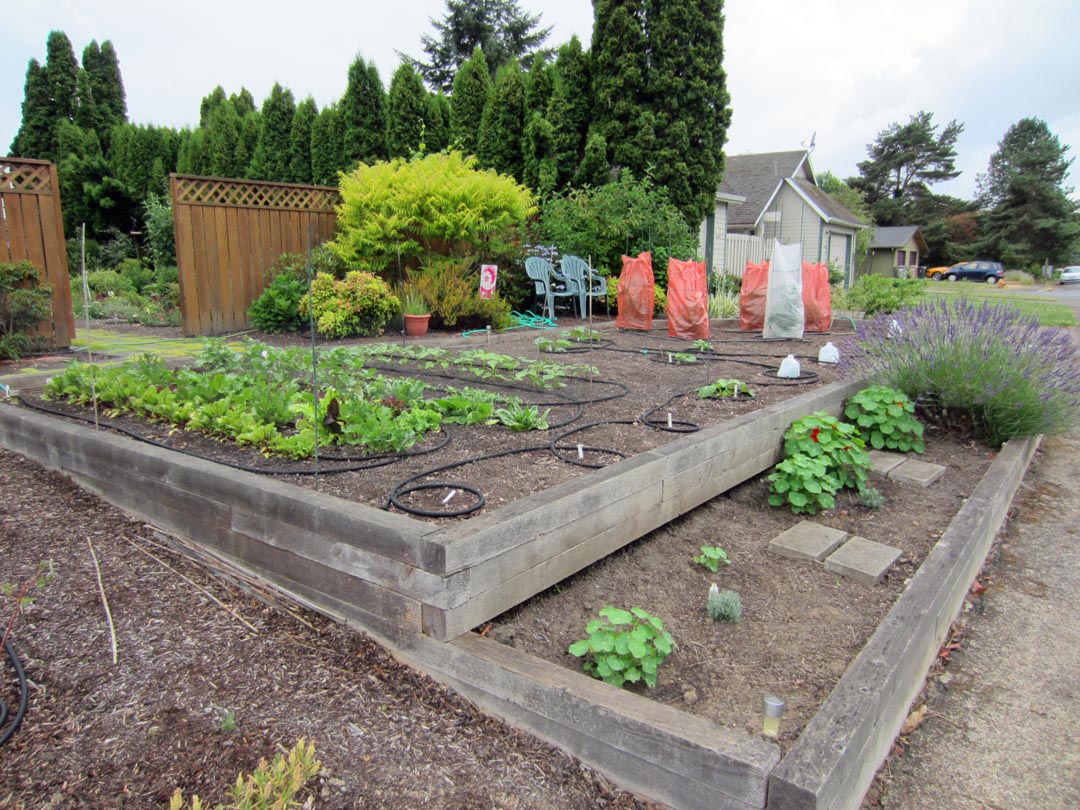
Entering the peak season of maturity: lettuce overlapping with bush beans, squash blossoms, baby zucchini, and green tomatoes!  July 23-2014

Entering the peak season of maturity: lettuce overlapping with bush beans, squash blossoms, baby zucchini, and green tomatoes! July 23-2014.

Hope everyone is enjoying summer in some manner!


The ladybug hatchery is hopping…on the hops

For whatever reason, the hops plant outside the front door, whose vines screen the patio area from direct street view became a designated ladybug-generating factory.  This also means that there was an aphid attack.  The plant has never had insect problems before, but like my apples and some other plants that normally never get visited by aphids, this is the year of infestation, in spite of a very cold winter.

Hops hatchery

The hops ladybug hatchery and nursery.

Normally, the honeysuckle serves as the garden’s aphid residence, and the rest of the plants are spared any infestations.  The stalwart honeysuckle starts to look very shabby by the end of June, its new buds barely able to blossom forth before being smothered by aphid larvae, but it has no problem surviving.  I remain grateful to it for its sacrifice in this way.  Ladybugs hang out on it also, but don’t ever seem to gain the upper hand in controlling the aphids.

Never before have I seen so many immature ladybugs in so many stages of development,on a single plant, and I have no idea where the adults came from.  Perhaps some neighbor released a packet of several hundred, and, typical of these creatures, they left their original release area in search of food elsewhere.  It’s a blessing to have so many of these beauties around, contributing their assistance to the bounty!  And they always bring smiles to people’s faces.

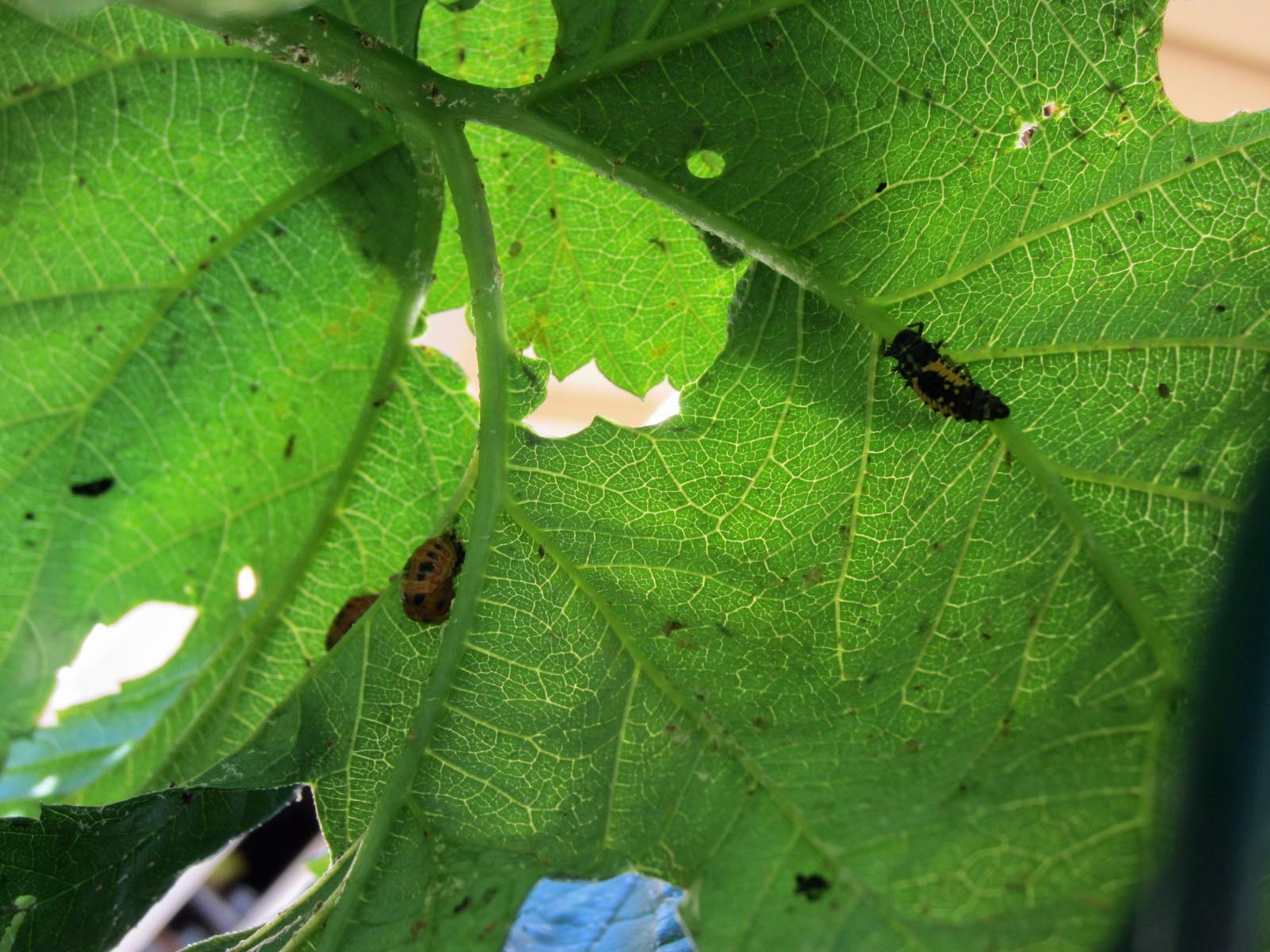
Various stages of ladybug beetle larvae.  The dark "spots" are eggs that eventually "hatch" into the larvae, of which there are several sizes here.  Once they molt 3 times as larvae, then they become pupae (like the one closest to center), before they transform into the adults we are more familiar with.

Various stages of ladybug larvae. Eggs are typically a yellow-orange color, that eventually “hatch” into the larvae, of which there are several sizes here. Once they molt 3 times as larvae, then they become pupae (like the one closest to center), before they transform into the adults we are more familiar with.

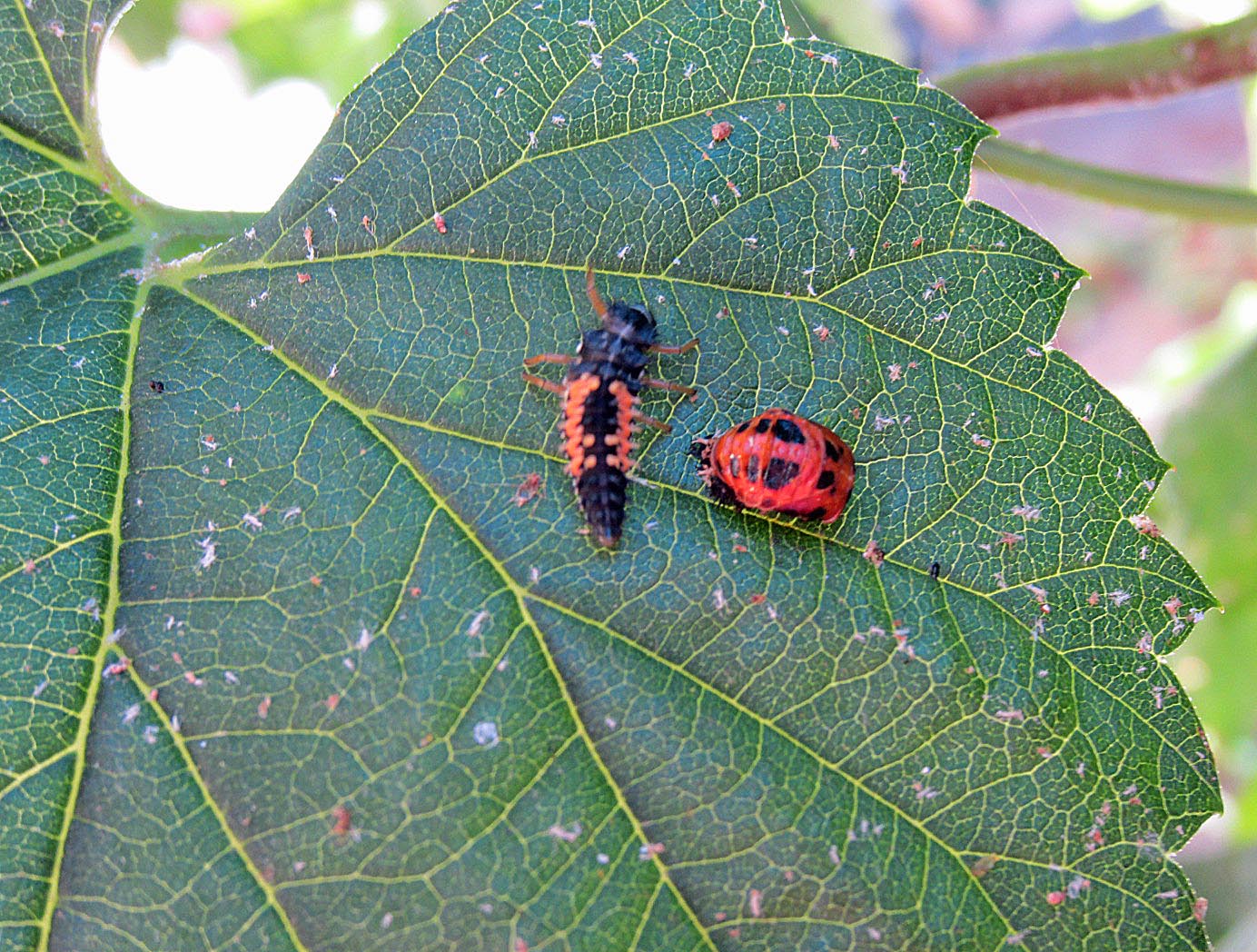
A beautiful picture of two non-adult ladybugs.  The one on the right is almost an adult, but still has no wing differentiation; it is the pupal stage, occuring just after the larva on the left molts 3 times.  The youngster larvae are voracious eaters. Adults also eat plant pests such as aphids, but are designed more for their beauty, ability to fly off elsewhere, meet other adults, lay more eggs, and ensure the survival of the species...;-)

A beautiful picture of two non-adult ladybugs. The one on the right is almost an adult, but still has no wing differentiation; it is the pupal stage, occurring just after the larva on the left molts 3 times. The youngster larvae are voracious eaters. Adults also eat many aphids, but function more as re-locators, flying off elsewhere, meeting other adults, laying more eggs, and ensuring the survival of the species, all in the general time frame of 1 month…;-)


No deer here!

This is what we like…”invisible” fencing that deer really don’t like because it is so hard for them to see.

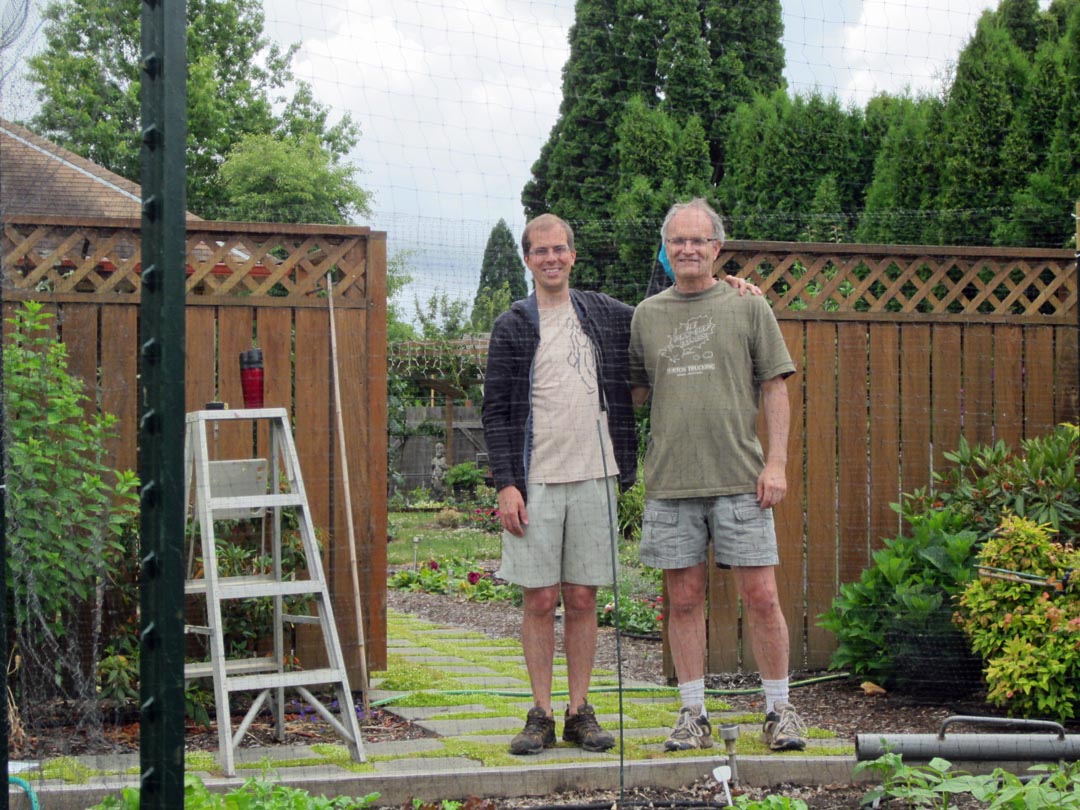
The "super-guys" modestly not showing off their muscles after post-digging.   Nice netting...can hardly see it!

The “super-guys” modestly not showing off their muscles after post-digging. Nice netting…can hardly see it!

Finally protected, just in time to remove all covers and jackets on the CG inhabitants.  With gratitude to the generosity of best friends with muscle power, the fencing got put up in a couple of hours, and looks great.  It is so much easier being able to walk inside freely instead of pulling back netting.

Yep, still level-headed after pounding posts!

Yep, still level-headed after pounding posts!

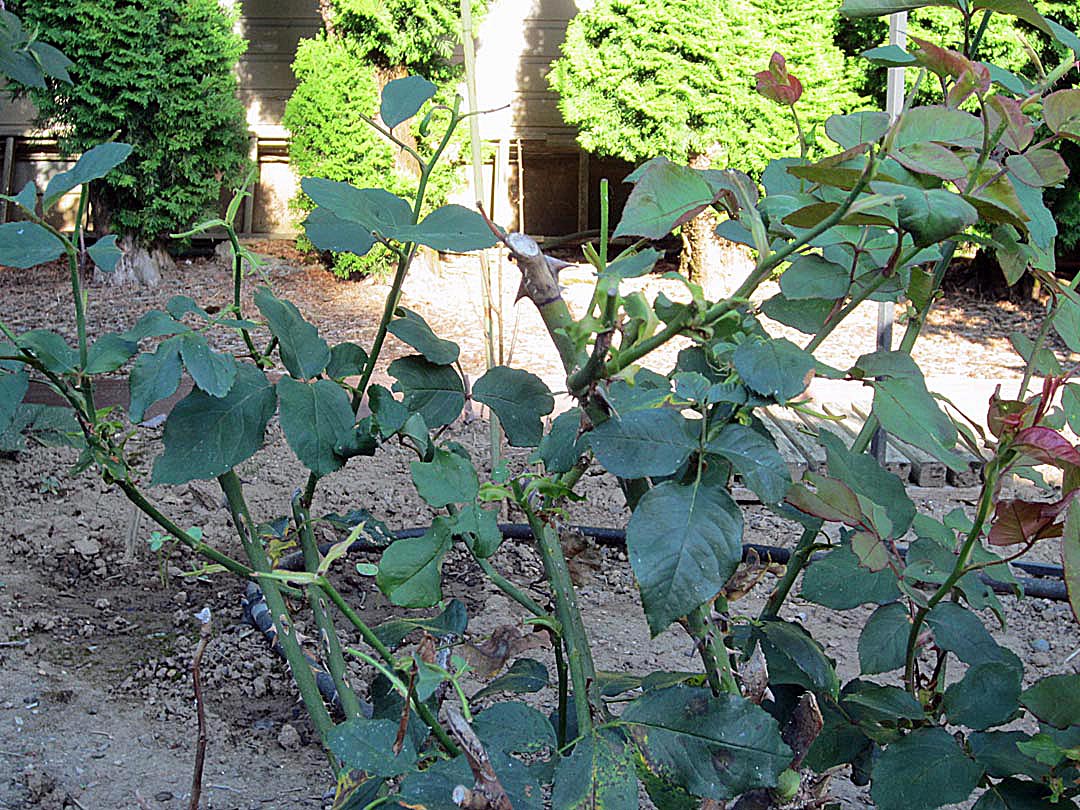
But these 4-leggeds are persistent in browsing, and decided if they can’t have lettuce or beans, then they’ll nibble some dogwood tips a few feet away.  They still manage to wind their way in from the neighbor’s garden when our barriers are not perfectly intact, and continue to harass my roses. and apples in the house yard.  Perhaps I will still see some small rosebuds this fall.

BrowsedRoses

Still no roses this year. The browsers escape into the garden through neighbor’s hedge on occasion.

Young lavender are playing sentinels for the recent melon sprouts in the pots.

Lavender seedling sentinels for the sprouting melons.  Keep those deer browsers out!

Lavender seedling sentinels for the sprouting melons. Keep those deer browsers out!

In between the gaps…a gallery

A glimpse into the menagerie of the community garden and general house yard through fall and winter 2013/2014.

Always like to show off what our browsers can do when they put their minds to it.  Push down that netting to get the delectable bean leaf tips! They've developed finesse so they don't get their teeth caught in the netting...

Always like to show off what our browsers can do when they put their minds to it. Push down that netting to get the delectable bean leaf tips! They’ve developed finesse so they don’t get their teeth caught in the netting…

Apologies to our beautiful praying Mantis, who is probably eyeing an insect or two under the netting.  What a beaut!

Apologies to our beautiful praying Mantis, who is probably eyeing an insect or two under the netting. What a beaut!

Tasty greens sprouting for fall crop.  Mature beets further right even overwintered well under the snow pack.

Tasty greens sprouting for fall crop. Mature beets further right even overwintered well under the snow pack.

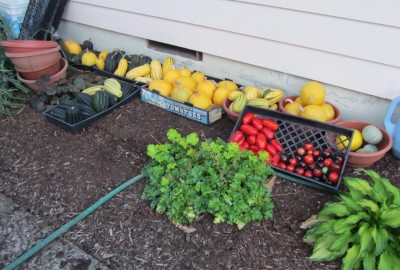
The typical way we keep the squash, melon, and tomato harvest aired and dry during the mild, not-too-rainy days of fall....stored under my eaves.

The typical way we keep the squash, melon, and tomato harvest aired and dry during the mild, not-too-rainy days of fall….stored under my eaves.

A record-setting snow-then-freeze episode the very first weekend of December 2013, followed by a record-setting snowfall in early February 2014, made us very aware of how little we can predict anything anymore, or when our gardens are tested to the maximum adaptability, and how miraculously resilient plants can be.  The witnessing of when a healthy, mature plant “decides” it will not struggle to survive the next year, but yield to the new energies of the next generation of seedlings.

Where's the bench seat?!

Where’s the bench seat?!

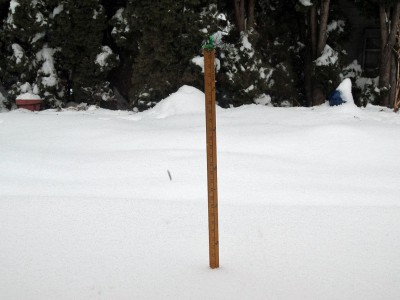
How Deep? 020814

14″ AFTER the snow has packed down for 3 days…

The birds had to learn to eat snow on their feeder for a few days.  Thank goodness for seeds on the old flower stalks, although the snow buried a lot of those.

The birds had to learn to eat snow on their feeder for a few days. Thank goodness for seeds on the old flower stalks, although the snow buried a lot of those.

And spring brings the energy of renewal…

2014-Kiwi Arbor-a

Kwan Yin being sheltered by a bower of the Siberian kiwi vine.


A year gone by, surely you jest!

The summer Solstice energies always help things get growing...sometimes too fast...bolting radishes!

The summer Solstice energies always help things get growing…sometimes too fast…bolting radishes and arugula!  Garden is awake!

I don’t even try to mentally grasp at the reality of a whole year gone by since last posting. It does feel like there are several timelines moving simultaneously, and depending on what I am doing there is rarely a sense of linear time, except for specific moments “in time”. This is the true reality, non-linear time that is, so a year feels like a month or two, sometimes, and at times a week feels like two months ago.

Many wonderful happenings and blessings in life have manifested over the last year, and there is not a lot of time left for keeping garden updates. I surely have mentioned that it is enough work just taking care of the garden after a job! The entry of a companion into my life has broadened my horizons once again, and his generosity in embracing me into his very active life has provided new opportunities to travel, as well as a busier schedule than I was used to. When he sustained a skiing accident in mid-February, my life-roles expanded further into helping him heal from pelvis and hip fractures. Fortunately he is very ambulatory these days, but healing will continue for up to a year, all said and done. Complete recovery, but a slow journey. This spring it was all I could do to bring my focus to engage the CG and get it up and running. February became May before I knew it.

Rereading last year’s entry regarding spring weather in 2013, which I don’t remember one iota, it doesn’t seem so different from this year. We’ve had a long stretch of mild, dry weather in May and June, now being balanced with a touch of late June rain. As usual, the tomatoes are still cloaked in their finest red jackets, probably till July 4, or when the new deer fencing goes up.

We had one of the most severe winters I can recall in my 35-year tenure here, and it was interesting to see plants survived two cold events. The first event occurred the first week of December, 2013, when the southern Willamette Valley received about 1 foot of snow in a couple of days, accompanied by sub-freezing temperatures that lasted for nearly a week. I had the pleasure of stepping into a foot of snow with only my Chacos on, arriving home at 2:00 am from a week-long vacation in Mexico. This was the event that probably killed off many old hedges around town and all my Spanish lavender (the English type held up fine).

Then came the huge snow load of February 7th, when it snowed upwards of 15” in 48 hours; yes, record-setting for that rate! However, it wasn’t overly cold during that session, but the lavenders were completely covered. The snow probably insulated the seed pods, which did sprout a plethora of seedlings in front of the CG, almost like a little carpet. These will eventually be planted out again to replenish the Spanish type (Lavandula stoechas). The old L. stoechas and L. viride in front had to be removed, and were replaced mostly with the hardier L. angustifolia.
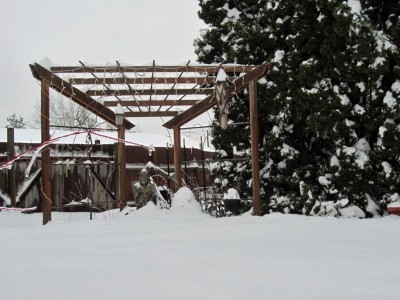
If Quan Yin is just over 3 feet tall...

If Quan Yin is just over 3 feet tall…

The bambi/es made their presence known early on this year, before the CG was even put in, dessimating my roses twice, so there are absolutely no flowers, and inhaling two of our newly-acquired tomato seedlings for the CG. Roses I am not so attached to, but….

A bumper crop of Lakemont seedless white grapes after a hard winter.  Was it modified pruning, or signs of plant maturity?

A bumper crop of Lakemont seedless white grapes after a hard winter. Was it modified pruning, or signs of plant maturity?

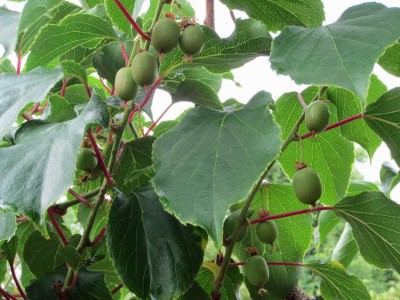
The odd weather affected flowering of the pear and columnar apples in the house yard, so there is absolutely no fruit this year. On the flip side, I have never seen so many grape clusters on a still-young grapevine, and I have done cluster thinning for the sake of the plant. And, for the first time, my Siberian kiwi is fruiting.  Now 5 or 6 years old, there appear to be a couple dozen small fruit. They aren’t lying about kiwis needing to be at least 5 years old before they start maturing, but I was starting to hold my breath because there were only a few blossoms last year that did not yield fruit. This is like a bumper crop!

Here’s to a bountiful year!

Success!  After 5 to 6 years, and a hard winter, several dozen Siberian kiwi fruit have manifested.

Success! After 5 to 6 years, and a hard winter, several dozen Siberian kiwi fruit have manifested.