Category Archives: Seasons

Emergency evacuation: pests out of control!

In a fast move to save the lettuce seedlings being savagely eaten in an outbreak of both aphids and Cabbage White Looper caterpillars migrating from the neighboring chard and kale, an emergency evacuation took place.  Thanking the plants for their extremely productive service, all kale and chard was removed, salvaging what little was decently usable as food, but discarding most directly into the waste debris containers.  This is what we get for “slacking off” in observation given our really busy schedules last week, while there was a burgeoning plague.  I had noticed a few tell-tale signs of building aphid populations on the kale, as well as white flies, but nothing had seemed in imminent danger. Then the Swiss chard seemed to become inundated with aphids almost overnight.  Evidently, behind that were lurking newly hatched Cabbage loopers, always unseen until they wreak havoc, stripping plants to their ribs in only 1 or 2 nights.  Even with eradicating the plant host-sources, and spraying Thuricide* on the lettuce, we could still lose the whole row, but hopefully not.  We’ll know in a day or two.

It was also good incentive to tidy up other areas in the garden looking a bit more distressed, removing the cucumbers and ‘delicata’ squash plants, and trimming back the sprawling cherry tomatoes.
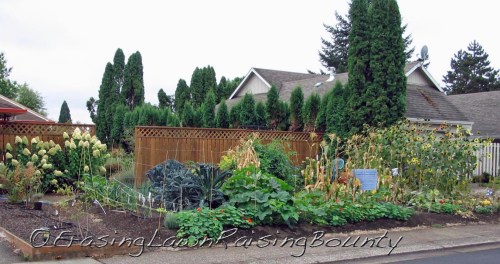
"Looking good" yet hunry pests lurk in the chard and kale.  So, now you see us.....
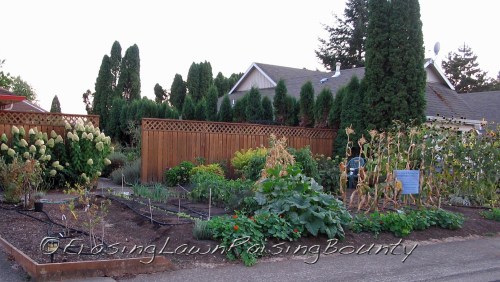
"Looking good" yet hunry pests lurk in the chard and kale. So, now you see us.....

Free of aphids and ...........

.........Now you don't! And the lettuce seedlings are much happier.

*Thuricide is a liquid comprised of millions of spores of the bacterium Bacillis thuringiensis, which reproduce inside the gut of specific types of caterpillars, becoming fatally toxic in a very short time.  This is a naturally occurring bacterium that evolved into its specific function.

Equinox equilibrium

We are entering one of my favorite times of the year, even if it means many plants are no longer in their prime.  It is the seasonal shift and natural waning of energy.  It is the fulcrum and midpoint between the longest and shortest days of the year; the day of the year when every place on earth experiences the same amount of day and night.  Indeed, we’ve noticed the darker mornings and shorter evenings over the last two to three weeks.  One can feel the garden’s slowing pulse, as many plants continue to ripen their fruits, almost as if in suspended animation.  Of course, there are other plants who rejoice at growing in cooler weather again, but it is not the logarithmic pace of spring and early summer.

Yet it is quite the paradox when the local temperature is trying to challenge a record high, more typical of summer, while the silver maples have branches of vivid red leaves!  Still, if one is attuned to energetics, 92° in late September is much more mellow heat than 92° in late July.  A very loud cricket has been keeping me company as I write, quite content that it is a warm evening.

My concerns that the supposed spaghetti squash might be imposters were assuaged after cutting one open and baking it.  The classic string texture was apparent upon scraping, and it was delicious, tossed with a bit of olive oil, garlic powder, salt, cherry tomatoes, and grated parmesan.  As a nice alternative to pasta, it is also tasty when mixed with pesto, though it takes a back seat to the pungent basil and garlic flavors.

Spaghetti squash galore!

Spaghetti squash galore!

A comedy of errors

What would gardening be without some mishaps, failures, or faux pas to keep us humble? The mysteries of  “why did this happen”?  So, I am offering a sort of “comedy of errors” to keep us amused while the main part of the garden hangs in a sort of suspended equilibrium.

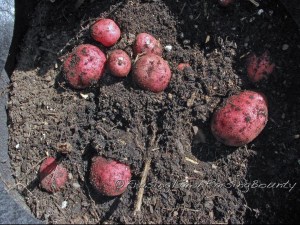
You’re looking at a 2-pound harvest of new ‘Cranberry red’ potatoes there in the next picture.  An exceptionally good amount considering nearly 1 pound of eyes were planted!  And the Yukon Golds  and Banana Fingerlings each yielded the same amount.  This is almost worthy of a booby prize!

'Cranberry Red' potatoes being dug up from growing bags

'Cranberry Red' potatoes being dug up from growing bags

I definitely don’t have potato production down (taking place in my house yard in deep, black, breathable “growing bags”).  I had a better crop last year, when I didn’t know much of anything except to keep adding layers of soil.  After reading up on some of their preferences, it’s possible that really hot weather hit at an early stage in their growth, which they don’t like, and I may not have kept them as moist as they like, given their well-drained soil mix.  If I were a grower I would be calling this a loss.  The potatoes are disease free and good looking, just tiny; the vines seem to have thrived early on, but after the really hot weather in July they started floundering.  My suspicion is they were nutrient-starved as I probably forgot to put in some fertilizer in first.

Upper left: Fingerlings (well maybe finger-nail-ings); upper right: Yukon Gold; lower: Cranberry Red

Upper left: Fingerlings (well maybe fingernail-lings); upper right: Yukon Gold; lower: Cranberry Red

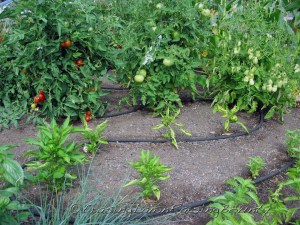
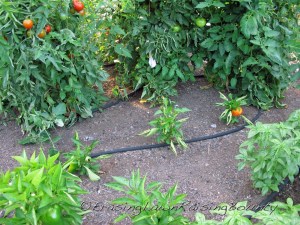
Then, there are the “little peppers who could” or my “comedy team”.  Three little bushes pushing out orange peppers as if their lives depended on it (which is what a stressed plant will do).  Two of their neighbors grew out of their stupor and are each pushing out 2 or 3 full-sized peppers.  Hey, at least the nearby basil took off.  Actually, the stunted pepper syndrome has something to do with light availability, too, as they were shaded much of the day by tomatoes, come mid-July.

The comedy team peppers barely hanging in there 10 weeks after planting!

The comedy team peppers barely hanging in there 10 weeks after planting!

The comedy team peppers 17 weeks after transplant-Sept. 2009

The comedy team peppers 17 weeks after planting-still hanging in there, now orange!

The weather continues to yo-yo by 10-degree increments for the daily high temperatures. The lettuce, basil, tomatoes, and chard are growing well, while cucumbers are putting out their last fruits, and the summer squash pushing out their last little groups of flowers where the newest growth is free of mildew.  The now-giant kale is robust and still sweet, but is succumbing to aphid egg infestation, and difficult to clean.  I think our resident ladybugs scattered away some as the old corn stalks were removed.  A short row of purple bush beans survived the deer-browsing from 2-weeks ago and are delivering the goods, although their green bean companions got hit again last weekend, and aren’t long for the world after being half pulled out while still small.  For anyone unfamiliar with deer browsing on beans, they don’t want the beans, they want the leaves, which is great if the plants are fully matured and no longer producing.  (Time for a bigger piece of netting, now that our deer is getting more daring.)   Next it’s time to start sampling the spaghetti squash!  We humans, that is, not the deer.

September showers are good for….a change of pace

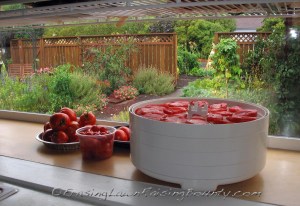
The weather devas decided that it was time to clear the air with a good rain for at least half of Labor Day weekend.  In anticipation of serious showers many tomatoes were gleaned the prior evening, to prevent splitting.  When the steady showers picked up on Saturday we knew it had been the right decision, even if the bushes now looked “green” without hardly a ripening tomato. It was a good chance to focus on inside food preparation, like making sauce, or starting up the dehydrator.  Not quite sun-dried tomatoes, but a close equivalent.

BowlofBigBoyTomatoes-2

Tomato rescue before rain set in....

A rainy day task - drying tomatoes for winter

A rainy day task - drying tomatoes for winter

It’s been a good change of pace, spending time with all the other inside jobs one neglects when spending most of the time outdoors.  Spiders of all sorts are quickly spinning webs, even in the bath tub.  After two days of good rain showers the garden looks refreshed, although mildew has set in upon the squash and cucumbers with a vengeance.  Kale and chard keep growing like gangbusters, the basil is finally getting really bushy after a few prunings for pesto sauce, and another crop of bush beans is just about ready. The good news is we are warming again in a few days to nearly 90°, so we can ripen more tomatoes!

August Bounty

The August pickings total as follows (in pounds):

•    Summer squash:    53
•    Cucumbers:             49-½
•    Swiss chard:              6-½
•    Kale:                           10-½
•    Beans:                         5
•    Peppers:                      ¾
•    Sweet corn:              19 (25 ears)
•    Tomatoes:                19-½
•    Eggplant:                   4
•    Scallions:                   1
•    Artichoke:                   ¾
•    Beets:                         1-½ (tops & roots)
•    Basil:                          2-½
•    Blueberries:              2
•    Potatoes:                   6
Grand Total:              182 (rounded off)

Total season bounty:  262

Thank you plants, pollinators, and devas!

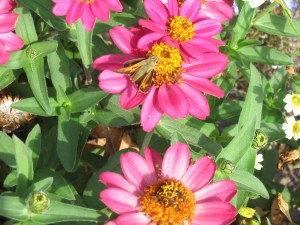
Juba skipper on 'Cherry Profusion' zinnias

Juba skipper on 'Cherry Profusion' zinnias

Getting the word out

We’ve been fortunate to have the local newspaper (Corvallis Gazette-Times) interested in publishing an article about the project, which was just released today.

Catch the online article at:
http://www.gazettetimes.com/news/local/article_595d9888-95da-11de-aef7-001cc4c002e0.html

The total August harvest tally will be posted tomorrow.

And, we really do exist!  We all had divergent plans that precluded a group photo in the newspaper article, but this is the “goof” photo that caught some interest….

Group photo-4

Slip, sliding away

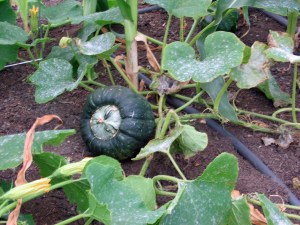
Alas, we’re officially on the downside and downslide of summer when the inevitable powdery mildew shows up on the squash and cucumbers.  The ‘Buttercup’ winter squash is the hardest hit, since it was shaded more as it wound its vines beneath the corn, so with the corn completely picked it was time to remove some stalks to let more light in for the squash and increase air circulation.

Powdery mildew on Butternut squash

Powdery mildew on Buttercup squash

Powdery mildew on yellow squash

Powdery mildew on yellow squash

Although commercial growers may apply chemicals to retard the formation of mildew, it really is a natural phenomenon that ties in with a change in season, via changes in temperature and humidity.

In town I’ve spotted a slight color tinge to some vine maples, and other plants are exhibiting their seasonal “green fatigue”.  Given the lower sun angle and record low temperatures of 41 during the last week, it may be time to use plastic over the tomatoes, at least at night.  After another interlude of partly overcast days, we’re due to warm up to the mid-upper 80’s for a stretch, but the heat won’t be the same.

Meanwhile,  a new group a ‘Rainbow’ Swiss chard is sprouting well, along with a row of lettuce.

Stay tuned for the end-of-month tally next week……

Double-takes

This week we had a couple of double-takes as the garden yielded fused corn and fused squash…

Double-takes on sweet corn

Double-takes on sweet corn

Double-takes on yellow straightneck squash

Double-takes on yellow straightneck squash

Our “browser” deer, who I believe to be a yearling-buck, may be trying to educate himself about mature versus green tomatoes.  Either that, or he got spooked and dropped the green Roma tomato.  Better to nibble off all the tips of the young bean plants!  And, thanks to the lavender plant stashed against the row of chard, he only nibbled 2 or 3 leaves.  The Irish Spring odor must have worn off the ropes over the last couple of days.

A deer-rejected Roma tomato!

A deer-rejected Roma tomato!

The new (third?) wave of yellow squash is coming on as a heat wave hits us again this week, after an unseasonably cool two weeks. The dreaded “powdery mildew” just began to make an appearance on the bushcrop squash, so now we’re officially on the downside of summer, and we hope the night temperatures will rise back to the 50’s during this last summer hurrah, since the large tomatoes are so slow to ripen.

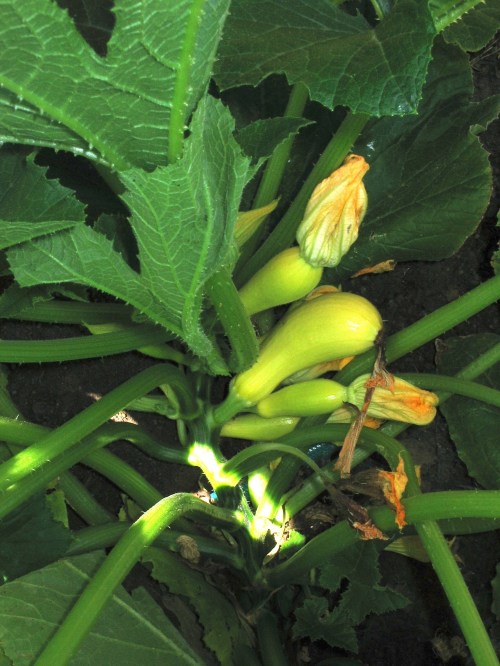
Squash sextuplets and this is only one group!

Squash sextuplets and this is only one group!

We’re also pleased that our new sign arrived during the week, along with small business cards, so curious passersby can learn a little more if they’d like.

New signage for project information

New signage for project information

Since I’m receiving more questions about caring for particular plants, I’ll be adding a separate page of general comments, though by no means exhaustive.  Thanks for the questions and comments that have been sent!

May we present……?

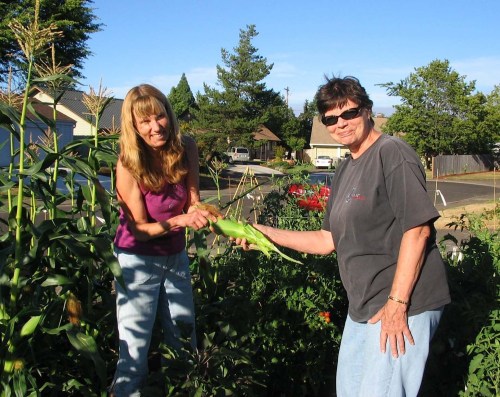
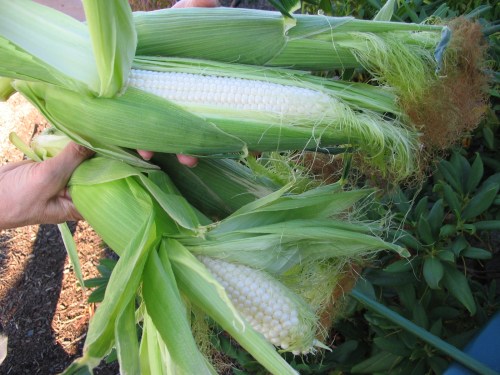
Gorgeous corn! In spite of inconsistent weather and some temporary nutrient deficiencies, our ‘Silver Princess’ sweet corn has matured and borne at least one ear per plant.  The tallest plants have 2 to 3 ears apiece, and one even has a fourth (immature).  Some ears are still filling out, but today (drum roll please) we harvested the first 5 ears! Almost clockwork to the day….70 days from planting.

First corn pickings and smiles of success

First corn pickings and smiles of success

Irresistible sweet corn var. Silver Princess

Irresistible sweet corn var. Silver Princess and not an ear worm to be found.

While enjoying our fresh, tender corn this week we’re keeping our eyes open for the next onslaught of squash and lemon cucumbers, after a slight respite.  And, contemplate when the dozen “personal size” spaghetti squashes will mature, and ponder if they really are what the package claims; fortunately they stopped growing awhile ago.  We’re also relieved to hear that formerly predicted “colder than average temperatures” for the rest of August won’t be likely; we need more warmth for our great crop of big, green tomatoes.

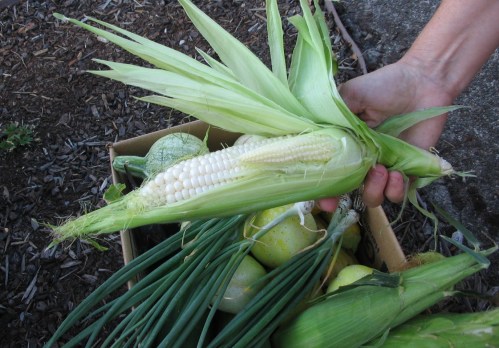
Colorful bounty: corn, eggplant, banana sweet pepper, cherry tomato

Colorful bounty: corn, eggplant, banana sweet pepper, cherry tomato

July Bounty

The heat spike of the previous blog has eased to the high 80’s, yielding nearly 10 pounds of summer squash in 4 days.  This marks the first donation of surplus food to a local food bank.  We’ve been overrun with squash and cucumbers, and that’s before the lemon cucumbers are coming on strong.  Our one casualty was a partially sun-scalded bell pepper, which had to be picked long before turning its intended orange hue.

Aug-01-09

The July pickings total as follows (in pounds):

•    Summer squash:    30 1/4
•    Cucumbers:             15 1/2
•    Swiss chard:             5 1/4
•    Kale:                          5 1/4
•    Beans:                       2
•    Peppers:                   1/4
•    Lettuce:                    6 1/4
•    Tomatoes:                 3/4
•    Eggplant:                  1
•    Artichoke:                 3/4
•    Scallions:                  1/2
•    Basil:                          1/8
•    Strawberries:            10
•    Blueberries:              1
•    Peaches:                     1/2
Grand Total:        80 (rounded off)

The sunflowers and yellow straightneck squash still appear to be competitive, thus said squash plant is now over 4 feet high, which makes for easier picking at times.  A squash “tree” more than a bush.  Today it looks as if the sunflowers took another bound upwards above 5 feet.  Will the squash try it?