Tag Archives: tomato

August Bounty

The August pickings total as follows (in pounds):

•    Summer squash:    53
•    Cucumbers:             49-½
•    Swiss chard:              6-½
•    Kale:                           10-½
•    Beans:                         5
•    Peppers:                      ¾
•    Sweet corn:              19 (25 ears)
•    Tomatoes:                19-½
•    Eggplant:                   4
•    Scallions:                   1
•    Artichoke:                   ¾
•    Beets:                         1-½ (tops & roots)
•    Basil:                          2-½
•    Blueberries:              2
•    Potatoes:                   6
Grand Total:              182 (rounded off)

Total season bounty:  262

Thank you plants, pollinators, and devas!

Juba skipper on 'Cherry Profusion' zinnias

Juba skipper on 'Cherry Profusion' zinnias

Slip, sliding away

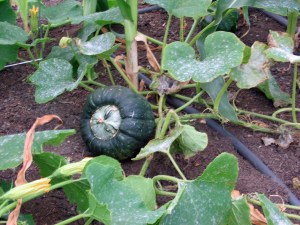
Alas, we’re officially on the downside and downslide of summer when the inevitable powdery mildew shows up on the squash and cucumbers.  The ‘Buttercup’ winter squash is the hardest hit, since it was shaded more as it wound its vines beneath the corn, so with the corn completely picked it was time to remove some stalks to let more light in for the squash and increase air circulation.

Powdery mildew on Butternut squash

Powdery mildew on Buttercup squash

Powdery mildew on yellow squash

Powdery mildew on yellow squash

Although commercial growers may apply chemicals to retard the formation of mildew, it really is a natural phenomenon that ties in with a change in season, via changes in temperature and humidity.

In town I’ve spotted a slight color tinge to some vine maples, and other plants are exhibiting their seasonal “green fatigue”.  Given the lower sun angle and record low temperatures of 41 during the last week, it may be time to use plastic over the tomatoes, at least at night.  After another interlude of partly overcast days, we’re due to warm up to the mid-upper 80’s for a stretch, but the heat won’t be the same.

Meanwhile,  a new group a ‘Rainbow’ Swiss chard is sprouting well, along with a row of lettuce.

Stay tuned for the end-of-month tally next week……

May we present……?

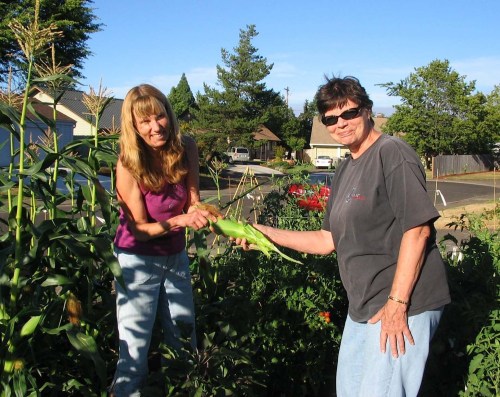
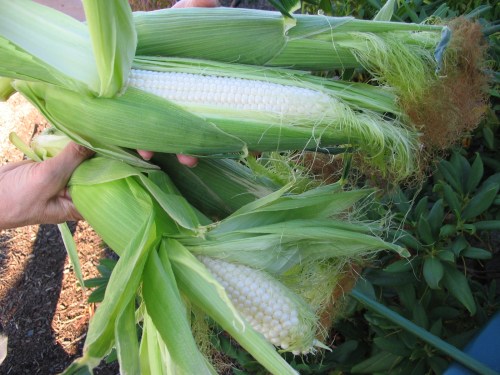
Gorgeous corn! In spite of inconsistent weather and some temporary nutrient deficiencies, our ‘Silver Princess’ sweet corn has matured and borne at least one ear per plant.  The tallest plants have 2 to 3 ears apiece, and one even has a fourth (immature).  Some ears are still filling out, but today (drum roll please) we harvested the first 5 ears! Almost clockwork to the day….70 days from planting.

First corn pickings and smiles of success

First corn pickings and smiles of success

Irresistible sweet corn var. Silver Princess

Irresistible sweet corn var. Silver Princess and not an ear worm to be found.

While enjoying our fresh, tender corn this week we’re keeping our eyes open for the next onslaught of squash and lemon cucumbers, after a slight respite.  And, contemplate when the dozen “personal size” spaghetti squashes will mature, and ponder if they really are what the package claims; fortunately they stopped growing awhile ago.  We’re also relieved to hear that formerly predicted “colder than average temperatures” for the rest of August won’t be likely; we need more warmth for our great crop of big, green tomatoes.

Colorful bounty: corn, eggplant, banana sweet pepper, cherry tomato

Colorful bounty: corn, eggplant, banana sweet pepper, cherry tomato

July Bounty

The heat spike of the previous blog has eased to the high 80’s, yielding nearly 10 pounds of summer squash in 4 days.  This marks the first donation of surplus food to a local food bank.  We’ve been overrun with squash and cucumbers, and that’s before the lemon cucumbers are coming on strong.  Our one casualty was a partially sun-scalded bell pepper, which had to be picked long before turning its intended orange hue.

Aug-01-09

The July pickings total as follows (in pounds):

•    Summer squash:    30 1/4
•    Cucumbers:             15 1/2
•    Swiss chard:             5 1/4
•    Kale:                          5 1/4
•    Beans:                       2
•    Peppers:                   1/4
•    Lettuce:                    6 1/4
•    Tomatoes:                 3/4
•    Eggplant:                  1
•    Artichoke:                 3/4
•    Scallions:                  1/2
•    Basil:                          1/8
•    Strawberries:            10
•    Blueberries:              1
•    Peaches:                     1/2
Grand Total:        80 (rounded off)

The sunflowers and yellow straightneck squash still appear to be competitive, thus said squash plant is now over 4 feet high, which makes for easier picking at times.  A squash “tree” more than a bush.  Today it looks as if the sunflowers took another bound upwards above 5 feet.  Will the squash try it?

High summer

When temperatures hover near 100°F my appetite switches gears in a big way.  No amount of fresh beans, chard, squash, tomatoes, or cucumbers can lure me to a green salad today, and especially not to cooking.  The last bit of bolting lettuce was plucked this morning to salvage a salad, maybe tomorrow.

First tomatoes were plucked a couple of days ago, and the squash are gearing up for another wave of production; lemon cucumbers are no visibly forming. Almost 6 pounds of green cucumbers were pulled this last week, which was a surprise.  Corn tassels and silk are promising signs of ear production as the plants have grown taller.  Bush beans abound and are a real hit, while thinned basil provides a delightful zest for pasta with garlic, salt, and olive oil.  Nonetheless, tonight’s dinner is cold cereal, cantaloupe, and a blueberry smoothie.

Tasty peaches, apricot sized!

Tasty peaches, apricot sized!

The prize picking was of the three small peaches that had formed on my new 2-yr. old dwarf tree.  I wasn’t sure when they’d be ripe, and when I went to inspect them under their little “pom pom” branch clusters, they released themselves easily with just a gentle nudge.  One was the size of an apricot, and the others a tad bit larger, very sweet and tasty nevertheless.

And the deer?  They’re watching and waiting; today I found evidence of some minor nibbling on the chard, kale, and bean tips.  Time to soap the lines again.  After I have my unorthodox dinner.

Knee-high by the Fourth of July

We’ve got knee-high corn!  What this means for a harvest date in the Willamette Valley is anyone’s guess, given the area’s propensity towards chilly nights in early July, even amidst near-90° heat. There have been tomatoes forming over the last couple of weeks, and there are 10 good-sized fruits growing on my Roma in the house yard, but they still may not ripen until August.

We’re hoping that this current 5-day heat wave will boost the bell peppers and scallop squash out of their stupors before the arrival of the next cool front of marine air moves in during this coming week.  As usual, our summer doesn’t really settle in for some days after July 8th.

Better than knee-high corn on July 4th.....

Better than knee-high corn on July 4th.....

Summer solstice

The corn is shin-high and we’ve got small tomatoes!  We’re having a relatively cool and blustery start to summer, most likely making up for 3 days of record-setting warm, clear weather over Memorial Weekend.  Thunderstorms passed, and for much of the last two weeks the weather has been cloudy, with beautiful sun breaks in the late afternoon, as southwest breezes come in.  The combination of warm soil and wind prompts near-daily watering for a few minutes.  We’ve had some chilly nights again, near 40°F, but there seems to be enough daily warmth for the tomatoes to keep growing; the squash and cukes are expanding and crawling.
The final scallop squash that was seeded 10 days after the others is still small, having missed the initial boost of heat during Memorial weekend.  It is simply waiting for some more heat to show up, which may be another week or so.

June 6-2009

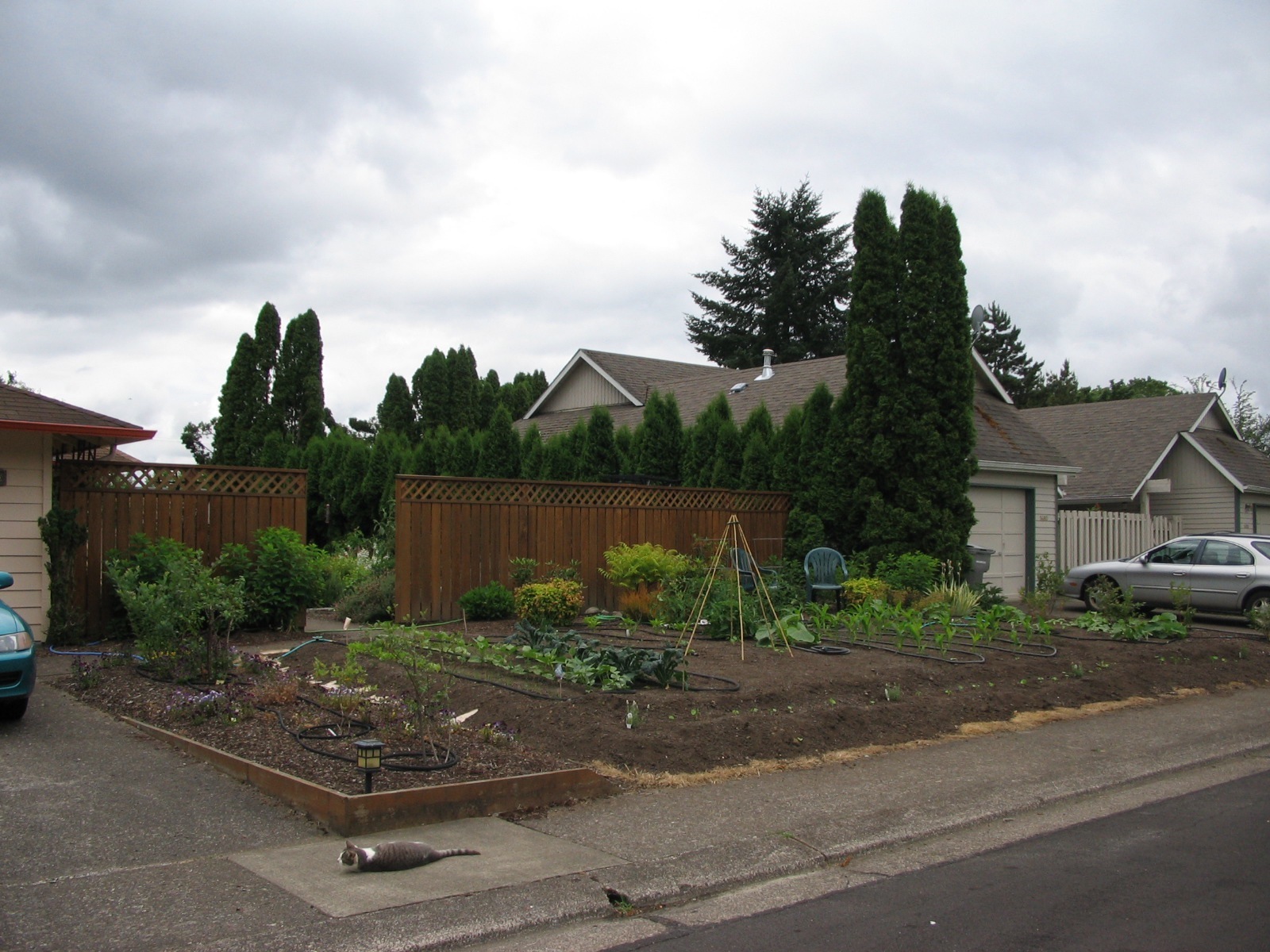
The garden on Summer Solstice-2009. Where's Juniper?

Squash, cucumber, and sunflower section; young blueberries off to the right

Squash, cucumber, and sunflower section; young blueberries off to the right

Yes, as other front yard gardeners across cyberspace will attest, these conversion projects tend to bring more interaction between neighbors.  On our little cul-de-sac we’ve all tended to acknowledge each other through the years anyway, but this has noticeably increased some formerly hesitant interactions.  Every resident has given a nod of approval or a thumbs-up to the new garden, which is always appreciated, even if they chose not to be part of it.

One neighbor teased that it is all “too orderly,” to which I laughed and promised to loosen it up a bit next year.  Then ensued a discussion about how some ancient cultures used to plant corn, beans, and squash seeds in the same hole, some 3” above a buried fish head.  Come to think of it, that might be a good experiment, substituting in organic fertilizer for the fish head.  The corn supports the beans, and the squash will wind around down below.  Good idea for tight “square-foot” gardening, too.  The beans would also contribute some nitrogen into the soil once nodules formed on the roots.

From another standpoint, corn is quite an “energy hog,” requiring a lot of nitrogen fertilizer to sustain its huge stalk, leaves, and a cob of high carbohydrates, plus a good shot of phosphorus to get that cob to flesh out.  And, all this just to produce 2 ears of corn on one plant, if the weather cooperates, and earworms don’t do much damage.  But, having never had a garden spot with enough full sun to even bother with corn, I wanted to try it out, as did everyone else.  Just a few ears for each of us would be plenty.  Plus, stalks add some vertical height and interest to the landscape.  We’ll see what happens.

June is busting out all over…

It is amazing how much has germinated in a week, thanks to warm weather.  More peppers and tomatoes have been planted, as well as climbing and bush nasturtium seeds, to add some color.  The weather has shifted to an unusual daily thunderstorm pattern, which will give us some watering respite.

Planting day……finally

Two days ago I set an oscillating sprinkler on for 2 sets of 1-hour duration, separated by 1-hour breaks, to dampen down the upper 4 to 5 inches of soil.  We’ve had a stretch of unusually warm weather during the week; moisture setting in nicely after the second day of soaking.

I spent most of today in the new garden spot, beginning at 8:00 a.m., contemplating and editing my layout while soaking the soil for another couple of hours.  The Ferti-loam mix is wonderful; not a weed has shown up yet.  With our spell of hot weather, the raised soil bed is wonderfully warm, perfect for planting corn and other warmth-lovers.  Lettuce won’t be done until later summer.

Participating neighbors dropped by to help spread organic fertilizer on the beds and rake it in.  Soaker hoses appeared, and I started configuring the hose systems, not that they’d be used right away.

Planting proceeded quickly after 5:00 pm., when westerly breezes arose; stores ran low on various plants, so not everything planned was planted.  More bell peppers and tomatoes are still needed.

The morning after.....planting that is.  Where's Juniper?

The morning after.....planting that is. Where's Juniper?

The overall planting includes:
5 tomato plant varieties
6 yellow bell pepper plants
3 summer squash (seeded): patty-pan (or scallop), round zucchini, yellow straight-neck
3 winter squash (seeded): delicata, spaghetti, buttercup
3 cucumber plants: lemon, sweet-slice long, bush crop
2 Japanese purple eggplants
1 chives plant
1 parsley (seeded)
16 ft. of green bush beans (seed)
8 ft. of rainbow Swiss chard (seed)
8 ft. scallions (bunching onions) (seed)
4 rows (@ 6 ft.) white corn (seed) to yield 24 plants total
6 kale plants
8 sunflowers (seeded among the squash plants)
6 vine-type nasturtiums to climb bamboo teepee (seed)
15 bush nasturtiums to stabilize and color the front edge of the bed (seed)
8 basil (seeded)
3 lavender plants (move in fall)

Amendments and supplies:
5@4-lb.boxes of E.B. Stone Organics All Purpose Plant Food (5-5-5); raked into top 3 inches of soil; furrowed under corn rows.
Tomato cages
250 ft. of soaker hoses
150 ft. of solid hose (3@50 ft) to connect soakers to house faucets
Brass or plastic multi-channel hose-connectors
Many large cardboard boxes to cover the entire 600 sq. ft. of lawn