It’s squash vs. sunflowers…

Our crazy, often cold weather hasn’t been the best for fast sunflower growth, so now we find them almost engulfed by several squash.  I’ve had a talk with them, urging them upward.  They reply, “Get us some consistent, hot days and warm nights, please.”  Granted, they look better than the yellow California Wonder peppers, who have stubbornly refused to grow.

Some of the summer squash and cukes have been hiding their offspring under their huge leaves, and although we’ve been peeking, the plants are pulling their usual “overnight babies.”  We’ll be starting to harvest yellow straightnecks and the cue-ball zucchini, and a few cukes in a few days, provided yesterday’s rains didn’t rot anything.  Hopefully not too many blossoms were damaged, and the predicted hot weather is to arrive tomorrow.  The scalloped Patty-pan in the house yard is bearing 2 or 3 small squashes, so they’ll be ready soon.  Quite a few small spaghetti squash are forming on their vines, too, which is a great sign.

Picked the first quart of blueberries (var. Bluecrop) of our joint blueberry patch last evening when the rain let up.  Most were ripe, with a couple of tart ones mixed in; mainly didn’t want deer or birds picking them! There are other varieties ripening up.  Since these are first-year transplants there are mostly one or two clusters max.  Instead of removing them early, as often suggested, we wanted to see how big and how long they take to ripen.

It worked!

Next morning, neighbor Patty feel asleep within a few minutes of getting up at 04:00.  I went out shortly before 06:00, as I’d planned, once my old cat went into his morning routine of waking me anywhere between 05:00 and 06:00 to feed him.  I was delighted to see no more browsing!  And, even with thunderstorms moving in later in the night, there was no evidence this morning of any damage.  I could still smell some residual Irish Spring soap odor on the lines, although very little odor on the soaked rag strips.  We haven’t seen any distinct hoof prints of the deer, but the Ferti-loam doesn’t hold any form wherever it is dry, and I think they were browsing from the edge of the row, while standing on the bark mulch around the blueberries.

Meanwhile, summer is further procrastinating, so we hear, for another two days, upon which temps will jump to 90°!  Today it is just clearing 70° and raining heavily as I write.  At least I got in a few hours of yard cleanup and transplanting (good weather for that!) beforehand.

Applied a foliar spray of fertilizer to the corn leaves, and raked in more granular 5-5-5 along the rows and around the bases of the bushing plants, to boost the nitrogen.  Having withheld water for 5 days last weeks, the plants already showed signs of greener new leaves, but I realized time had flown by and more fertilizer was needed by some plants.  It is quite different growing the veggies in this largely composted manure base, versus in my house yard where, given some of the same plants, there has been no deficiency.  However, they were watered less, and grew more slowly.  Plants are fascinating that way, as are “soil types” for that matter.

Dear deer…*@#!

I really had hoped and thought this event would be postponed until next year, but alas, it would be our garden that induced the deer to venture further into the neighborhood than they ever have before.  I’d heard they occasionally cruised by some open yards 3 blocks away, on the lookout for delectable gladiola flower buds, and knew it would only be a matter of time, since their pristine wooded areas ½-mile away are being developed for new residences. We hoped we wouldn’t have them on our street so soon; I already had plans to work some strategy in next year’s plantings.  It’s not like we are in an absolutely rural area, but we aren’t really urban either, in the classic sense.  Forests and hiking areas surround Corvallis, even if we’re on the flat.  Yes, we even have cougar in the hills.

So, they took out half of the chard, and nibbled on the bush bean tips; didn’t touch much of the kale, since it’s quite a bit tougher, nor did they seem to bother anything else……yet.  And, they must be so hungry, they got the nerve up to poke their noses just inside the walkway to the main house yard and nibble off the centers of the lettuce heads.  But, I’ve heard enough of their eating behaviors from my office mate at work to know what has to be addressed immediately.  If you actually have mature beans on a plant, the deer help out by eating everything but the beans, but since our plants are still growing and barely flowering, this is not good news.

Since I have a lot of lavender growing in other parts of the garden, we’ve decided to soak rags in a blended lavender bud and mint leaf solution.  Upon arriving home from work I found one neighbor had been very busy during the day, setting up 5-ft. bamboo sticks around the perimeter, stringing monofilament line between them, and hanging strips of rags soaked in the solution.  I had picked up a couple of bars of true Irish Spring from the “dollar store” and swooshed a bar around a bit in the solution to enhance it further.  While she strung more line and rags around the perimeter, I set up lines directly between the rows of chard and beans, stringing rags at plant “nibbling” height.  I quickly realized it might be just as effective to rub soap along the sissal twine, covering the row length.  Then rub all the perimeter lines, and then….most of the perimeter bamboo sticks!  By the time I had done this for an hour, I was coughing from the soap odors (I think), so it ought to deter the deer.  (I was tempted to get up early this morning to see if I heard any coughing deer.)  Some people put down shavings of soap around their gardens, but this was a faster process for the set-up.  Also put a few soaked rags in amongst the blueberry bushes with their ripening fruit.  (Another friend has successfully kept deer from nibbling on the succulent shoots of his espaliered apples by hanging strips of greasy rags he has left from maintaining his bicycles and various house projects.)
Finally, we decided to leave the remaining solution in the dishpan right out in the middle of the yard for the night.   We’ll see what happens…Stay tuned.

Where’s summer?!

We’ve got a great case of “the yellows” from over enthusiastic watering most likely, even if it has been in short spurts on a daily basis.  Possibly a combination with some fertilizer tie-up with decomposer organisms, too, but with our cool weather, I suspect more of a moisture issue.  It’s always interesting to see which plants are sensitive, even when adjacent to each other. The peppers and 2 squash are not pleased with this return to below-normal temps, nor are the basil seedlings, which had nicely greened up and grown over the previous 2 weeks.

Knee-high by the Fourth of July

We’ve got knee-high corn!  What this means for a harvest date in the Willamette Valley is anyone’s guess, given the area’s propensity towards chilly nights in early July, even amidst near-90° heat. There have been tomatoes forming over the last couple of weeks, and there are 10 good-sized fruits growing on my Roma in the house yard, but they still may not ripen until August.

We’re hoping that this current 5-day heat wave will boost the bell peppers and scallop squash out of their stupors before the arrival of the next cool front of marine air moves in during this coming week.  As usual, our summer doesn’t really settle in for some days after July 8th.

Better than knee-high corn on July 4th.....

Better than knee-high corn on July 4th.....

Summer solstice

The corn is shin-high and we’ve got small tomatoes!  We’re having a relatively cool and blustery start to summer, most likely making up for 3 days of record-setting warm, clear weather over Memorial Weekend.  Thunderstorms passed, and for much of the last two weeks the weather has been cloudy, with beautiful sun breaks in the late afternoon, as southwest breezes come in.  The combination of warm soil and wind prompts near-daily watering for a few minutes.  We’ve had some chilly nights again, near 40°F, but there seems to be enough daily warmth for the tomatoes to keep growing; the squash and cukes are expanding and crawling.
The final scallop squash that was seeded 10 days after the others is still small, having missed the initial boost of heat during Memorial weekend.  It is simply waiting for some more heat to show up, which may be another week or so.

June 6-2009

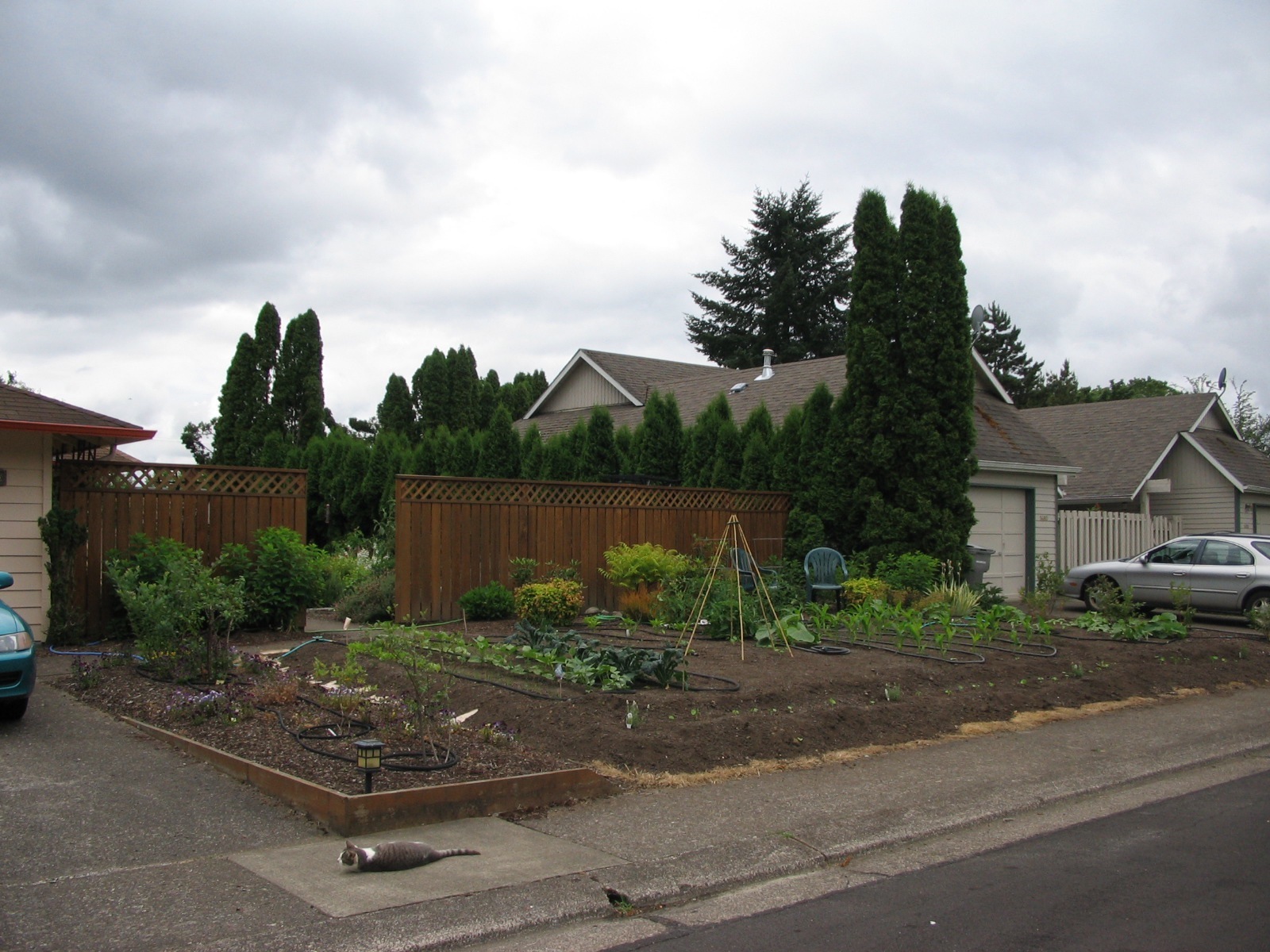
The garden on Summer Solstice-2009. Where's Juniper?

Squash, cucumber, and sunflower section; young blueberries off to the right

Squash, cucumber, and sunflower section; young blueberries off to the right

Yes, as other front yard gardeners across cyberspace will attest, these conversion projects tend to bring more interaction between neighbors.  On our little cul-de-sac we’ve all tended to acknowledge each other through the years anyway, but this has noticeably increased some formerly hesitant interactions.  Every resident has given a nod of approval or a thumbs-up to the new garden, which is always appreciated, even if they chose not to be part of it.

One neighbor teased that it is all “too orderly,” to which I laughed and promised to loosen it up a bit next year.  Then ensued a discussion about how some ancient cultures used to plant corn, beans, and squash seeds in the same hole, some 3” above a buried fish head.  Come to think of it, that might be a good experiment, substituting in organic fertilizer for the fish head.  The corn supports the beans, and the squash will wind around down below.  Good idea for tight “square-foot” gardening, too.  The beans would also contribute some nitrogen into the soil once nodules formed on the roots.

From another standpoint, corn is quite an “energy hog,” requiring a lot of nitrogen fertilizer to sustain its huge stalk, leaves, and a cob of high carbohydrates, plus a good shot of phosphorus to get that cob to flesh out.  And, all this just to produce 2 ears of corn on one plant, if the weather cooperates, and earworms don’t do much damage.  But, having never had a garden spot with enough full sun to even bother with corn, I wanted to try it out, as did everyone else.  Just a few ears for each of us would be plenty.  Plus, stalks add some vertical height and interest to the landscape.  We’ll see what happens.

Hail and deluge

Yay!  The garden has weathered its first deluge.  Today a very large and foreboding storm cell moved over the area around 3:00 pm.  While those of the last few days primarily brought brief, mild rain and boomers, this one had a distinct feel of “mischief and mayhem.”

Still at work, I requested assistance from the fledgling garden’s Guardians to shield it from hail and high winds, visualizing a clear glass dome over the entire area, including the rest of the yard, and the neighbors.  Upon arrival home two hours later, I was delighted to find all the seedlings and plants intact, especially in light of the storm’s ability to flood streets, dislodge soil in other yards, fry surge protectors and phones, and zap some trees in a short time.

June is busting out all over…

It is amazing how much has germinated in a week, thanks to warm weather.  More peppers and tomatoes have been planted, as well as climbing and bush nasturtium seeds, to add some color.  The weather has shifted to an unusual daily thunderstorm pattern, which will give us some watering respite.

Planting day……finally

Two days ago I set an oscillating sprinkler on for 2 sets of 1-hour duration, separated by 1-hour breaks, to dampen down the upper 4 to 5 inches of soil.  We’ve had a stretch of unusually warm weather during the week; moisture setting in nicely after the second day of soaking.

I spent most of today in the new garden spot, beginning at 8:00 a.m., contemplating and editing my layout while soaking the soil for another couple of hours.  The Ferti-loam mix is wonderful; not a weed has shown up yet.  With our spell of hot weather, the raised soil bed is wonderfully warm, perfect for planting corn and other warmth-lovers.  Lettuce won’t be done until later summer.

Participating neighbors dropped by to help spread organic fertilizer on the beds and rake it in.  Soaker hoses appeared, and I started configuring the hose systems, not that they’d be used right away.

Planting proceeded quickly after 5:00 pm., when westerly breezes arose; stores ran low on various plants, so not everything planned was planted.  More bell peppers and tomatoes are still needed.

The morning after.....planting that is.  Where's Juniper?

The morning after.....planting that is. Where's Juniper?

The overall planting includes:
5 tomato plant varieties
6 yellow bell pepper plants
3 summer squash (seeded): patty-pan (or scallop), round zucchini, yellow straight-neck
3 winter squash (seeded): delicata, spaghetti, buttercup
3 cucumber plants: lemon, sweet-slice long, bush crop
2 Japanese purple eggplants
1 chives plant
1 parsley (seeded)
16 ft. of green bush beans (seed)
8 ft. of rainbow Swiss chard (seed)
8 ft. scallions (bunching onions) (seed)
4 rows (@ 6 ft.) white corn (seed) to yield 24 plants total
6 kale plants
8 sunflowers (seeded among the squash plants)
6 vine-type nasturtiums to climb bamboo teepee (seed)
15 bush nasturtiums to stabilize and color the front edge of the bed (seed)
8 basil (seeded)
3 lavender plants (move in fall)

Amendments and supplies:
5@4-lb.boxes of E.B. Stone Organics All Purpose Plant Food (5-5-5); raked into top 3 inches of soil; furrowed under corn rows.
Tomato cages
250 ft. of soaker hoses
150 ft. of solid hose (3@50 ft) to connect soakers to house faucets
Brass or plastic multi-channel hose-connectors
Many large cardboard boxes to cover the entire 600 sq. ft. of lawn

Meeting time: who wants what?

A brief meeting of the participants to see who wants I to plant what, or buy what.  We’re down to 5 participants total, with a consensus to share and work the entire garden among us, rather than have individual plots.  I’m designated to plan the general layout.  Planting day is to be Memorial Day, May 25th, 5 pm.  For now, no “cool-weather” crops such as lettuce, cilantro, or cole crops (e.g., spinach, broccoli).  These will be planted in late summer, in areas where scallions and beans are harvested, and when the sun is lower on the horizon.  Also, no perennials to be planted this year, because I have plans to refine the borders of the beds in late fall (build structural support).

Watch for supplies and plants posted in the next blog, as well as here.